

Despite major investments, on-street electric vehicle charging in North America still struggles to keep pace with soaring demand and patchy infrastructure.
By Dunstan Power
On-street electric vehicle (EV) charging infrastructure in the United States has expanded significantly, with more than 215,000 publicly available charging ports nationwide — double the number since 2021, according to the U.S. Joint Office of Energy and Transportation. This growth has been fueled by the 2021 Bipartisan Infrastructure Law and private investment.
The growth in use of EVs creates both challenges and opportunities. On-street charging infrastructure, especially in residential areas, poses difficulties for local governments while offering potential for those with suitable locations.
The limits of home-based curbside charging
Various on-street charging options exist, each with different technical and financial considerations. Direct cables from homes are cheap but can be unsafe and often illegal. When stretched across sidewalks, they create tripping hazards and obstacles for wheelchair users and people with strollers. This basic solution costs between $500 and $1,500 for Level 2 chargers.
Although somewhat safer, underground cable conduits in pavement channels still depend on home electricity, may cause maintenance issues, and require official permission. Installation then costs an additional $500 to $2,000, depending on the space’s requirements.
However, both these home-based options have a significant limitation: They only work for drivers with dedicated parking spaces.
Repurposing the right-of-way for EV charging
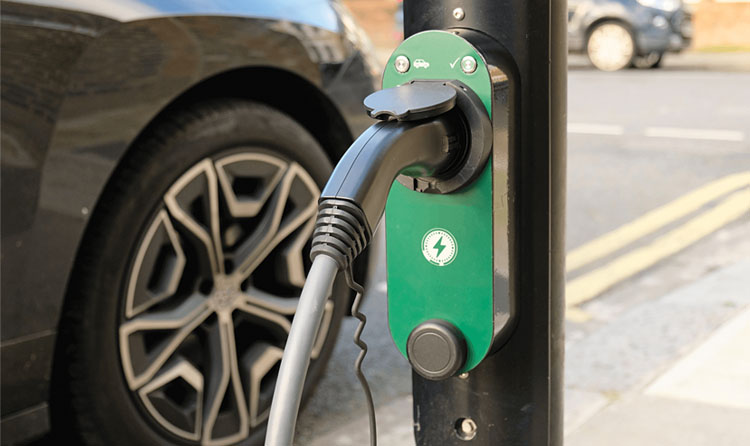
Although most EV owners charge at home, on-street charging remains critical for residents without private charging access, particularly in multi-family housing. Urban areas typically feature Level 2 chargers at curbsides. However, newer initiatives are converting streetlights into charging stations, as seen in the Detroit metropolitan area and across Michigan, via the partnership between telecommunications provider AT&T and Voltpost, a company that retrofits lampposts into a modular, upgradable Level 2 EV charging platform powered by a mobile app.
Adapting existing street infrastructure like lampposts for charging is possible but has limited geographic application. A UK trial attempting to convert the street-side telecom distribution boxes known as BT cabinets wasn’t successful because there weren’t enough cabinets and they weren’t conveniently located for charging. Their scattered placement provided poor coverage. Other street elements, including signs, phone boxes, and parking meters, could potentially be modified for charging purposes.
Because electricity in North America is often distributed via overhead lines within urban areas, the supporting poles can serve as mounting points for chargers. Although this approach simplifies installation, the irregular placement of poles and their distance from parking spaces restricts effective coverage.
Overhead charging frames and cranes offer the same benefits as sidewalk-crossing or trench-based solutions, letting drivers use their preferred pricing plans and chargers, but installation costs more. These systems present safety concerns related to space requirements, crane height, and exposed hanging cables. The solution often proves impractical, and securing permission to install one outside a home can pose challenges.
Public chargers: a solution still in progress
Drivers without guaranteed parking spots must rely on public chargers run by charge point operators (CPOs). These systems charge higher rates per kWh compared to domestic electricity prices, as this generates CPO revenue.
Public charging stations come in various designs. Standard Mode-3 AC chargers appear as roadside pillars with one or two sockets. They require costly groundwork and take up sidewalk space, making them suitable only for wider sidewalks.
Alternative designs include deployable charging poles that reduce clutter when not in use, and retractable pop-up chargers that offer better aesthetics, particularly in historic areas, though at a higher initial expense.
Created as part of the Bipartisan Infrastructure Law, the $5 billion National Electric Vehicle Infrastructure Program was set to develop charging networks in communities and every 50 miles along certain highways. In August 2024, the program announced $521 million in grants specifically targeting disadvantaged areas where on-street charging is essential. However, the Trump administration suspended the program this past February, though in May several states sued the administration, seeking to have it reinstated.
Against this backdrop, what do these events mean for those still needing on-street charging?
Distribution remains uneven. Major cities like New York and Los Angeles — which has more than 1,600 public stations, many on-street — have extensive coverage, while rural areas often comprise “charging deserts” lacking in public chargers.
Overall growth in EV charging installations in the U.S. is impressive, increasing by 6.3% in quarter 2 of 2024 alone, according to a November 2024 report from the U.S. Department of Energy’s National Renewable Energy Laboratory. DC fast chargers — often referred to as rapid chargers — saw a 7.4% rise, some of which are deployed on-street in high-traffic urban zones. However, challenges persist with inconsistent pricing and reliability: A recent study by researchers from the Georgia Institute of Technology and the Harvard Business School estimated that non-residential EV equipment in the United States works only 78% of the time.
Despite accelerating expansion through federal programs and private initiatives like the automaker Tesla opening its Supercharger network, EV charging infrastructure development still lags behind EV sales growth, particularly in densely populated areas lacking home charging options.
Extreme infrastructure strategies for long-term use in the USA
At the more ambitious end of the spectrum for enhancing EV charging infrastructure in the United States, existing buildings could be demolished and replaced with compact, multi-story EV charging stations. This approach eliminates the need for on-street charging in crowded urban areas, offering a dedicated space for electric vehicles.
The primary hurdles with that option are the cost and time involved. Acquiring suitable property, demolishing existing structures, and funding the construction of a multi-story charging hub demands substantial investment. Given these financial challenges, this solution is unlikely to become widespread across North America anytime soon.
Instead of relying on slower Level 2 AC destination chargers, some American EV drivers are turning to the growing network of DC fast chargers. For those worried about range anxiety, this can be a practical option. Many EVs available in the U.S., such as the Tesla Model Y or Ford Mustang Mach-E, boast ranges of 300 to 350 miles. If a driver only covers 20 to 30 miles daily, a single charge could last a week. With access to a nearby fast charger, like those in Tesla’s Supercharger network or the stations owned and operated by the EV charging network Electrify America, this setup can work well. However, the downside is the cost of public charging. Critics often point out that relying heavily on public fast chargers can make EV ownership as expensive as driving a gas-powered car, especially when compared to home charging with cheaper electricity rates.
Depending entirely on fast chargers might even surpass the cost of operating a small gasoline vehicle, such as a Honda Civic. As a result, while the U.S. has seen significant expansion of fast-charging networks, they’re not considered a sustainable long-term solution due to high usage costs. In contrast, AC Level 2 chargers, such as those commonly found at workplaces or in parking lots, are far less expensive to install than DC fast chargers. They should, in theory, offer lower per-kWh rates, though this isn’t always the case in practice. If these savings are passed on to users, Level 2 chargers could provide a cost-effective option for on-street charging in North American cities.
An inductive future in North America?
The ultimate vision for EV charging might be inductive charging, where chargers are embedded in the road, enabling drivers to park over them and charge wirelessly without any effort. Currently, however, inductive charging is rare in the U.S. market. Other than BMW with its limited pilots, few vehicle manufacturers offer compatible models. A likely starting point could be adoption by taxi fleets or municipal vehicles, a possibility that Tesla hinted it might pursue at its Robotaxi unveiling event in Los Angeles last October.
Although inductive charging may eventually become the norm, widespread deployment in American cities is likely a decade away. Installation costs will be steep, requiring roads to be excavated for charger placement and cabling. Usage fees are expected to reflect these expenses, though inductive charging offers unmatched aesthetics and scalability for urban streets.
However, innovative solutions are already emerging. For example, log chargers that are made of a real tree trunk and have built-in charging hardware are available, perfectly demonstrating how EV charging can blend into various formats. From street furniture to unexpected designs, the U.S. and Canada are poised to see more creative charging options as the market evolves.
Recommendations to meet demand in North America
To keep pace with growing EV adoption, U.S. states and property owners should take a proactive, strategic approach to planning charging infrastructure. Assessing current and projected EV usage, along with the capacity for different charger types such as Level 2, DC fast, or inductive, is critical when designing solutions for residential and urban areas.
Evaluating charging technologies based on performance, cost, safety, and visual impact is equally important. For instance, a bulky overhead charging structure might not suit a tight budget or a tree-lined street in a historic district like Charleston, South Carolina, or New Orleans. Leveraging existing electrical grid infrastructure while planning upgrades to handle increased demand could streamline deployment near homes, and collaboration with residents, businesses, and utilities is key to ensuring equitable access and addressing community feedback.
By tackling these challenges, North American cities and towns can build accessible, sustainable EV charging networks, supporting the shift to EVs and advancing a cleaner transportation future that mirrors what’s already happening in the UK and Europe.
Dunstan Power is the director of Versinetic. He can be reached at [email protected].