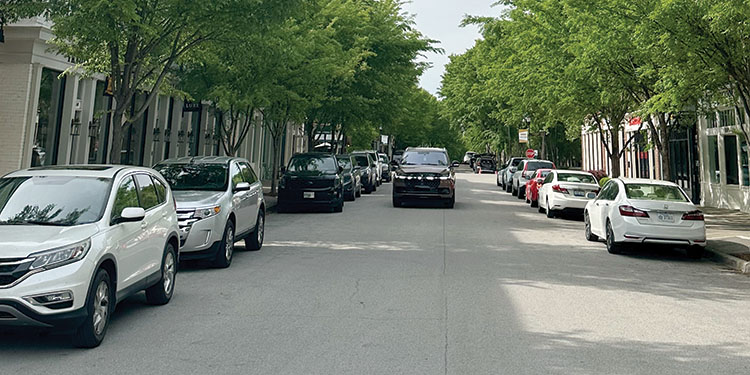


Modern parking requires customized technology solutions tailored to specific users and contexts rather than universal one-size-fits-all approaches.
By Kevin Bopp, Bernard Lee, and Andrew Sachs
For decades, the parking industry operated under the false comfort of a one-size-fits-all solution — gates and tickets. It was predictable, secure, and universally recognizable. However, if your parking strategy today looks anything like it did 10 years ago, you’re already behind the curve. The industry’s future is nuanced, often messy, and ideally customized. Although new technologies promise simplicity, they deliver complexity precisely because they force us to confront our actual needs, users, and contexts.
Understanding your facility and the expectations of its users isn’t just a nice-to-have: It’s the critical first step in modern parking access and revenue control system (PARCS) design. Effective operations require more than selecting “the best” system. In fact, there is no universal best — only what’s best for your objectives, priorities, and parking customers. Absolute simplicity emerges only after thoughtful, intentional complexity.
Technology tradeoffs
Every PARCS designer must juggle the following six primary technology options, each of which has inherent trade-offs:
• Traditional gated and ticketed
• Gateless with quick response (QR) code
• Gateless with license plate recognition (LPR)
• Gated with tickets and LPR
• Ticketless gated with LPR
• Register once with LPR
Traditional gated-and-ticketed systems are robust and reliable, but they are burdened with labor, maintenance, and overhead costs. Conversely, gateless solutions using QR codes strip away barriers, dramatically cutting hardware expenses, but rely heavily on smartphone adoption by users and constant enforcement vigilance. Although LPR offers frictionless convenience, it hinges on accurate plate recognition and seamless backend integration. When blended with traditional gates, LPR introduces powerful account management and dynamic pricing but retains infrastructural complexity.
Eliminating tickets altogether, gated systems leveraging LPR directly tie vehicles to digital payments and/or permitting platforms, which minimizes friction but requires sophisticated user interfaces. Register-once solutions epitomize frictionless convenience for recurring users, yet exclude casual patrons hesitant to commit their personal details and payment data to yet another app.
Pay-on-foot kiosks could be implemented to support all six technology options. These shift congestion points from exit lanes to lobbies and other high-foot-traffic areas, benefiting venues like hospitals and hotels, but risk alienating occasional users unfamiliar with the process. There’s potential unintended confusion if customers pay at a pedestrian kiosk but don’t know that they need to present the “paid” ticket in the exit lane. Moreover, there’s the added difficulty of individuals not leaving within the grace period such payments offer.
Contextual considerations
Land use adds another dimension of complexity. Single-use facilities, such as office buildings or hospitals, may seem straightforward, but paradoxically, they experience periods of low utilization due to their predictable occupancy patterns. Leveraging excess capacity requires deliberate partnerships with nearby demand drivers, forcing owners, operators, and even street-level parking attendants to extend their roles beyond parking management. To optimize parking asset utilization, successful owners and operators ideally act as limited economic strategists and community ambassadors. By acting in those capacities, opportunities to maximize occupancy and revenue can be achieved, while providing a benefit to the surrounding community by obviating the need to add new parking.
The garages and lots that support exclusively residential developments would appear even less capable of accommodating additional usage of their facilities. After all, residents reasonably expect to have available parking whenever they want to use those facilities. However, that means many spaces sit unused at any given time, while overselling those spaces comes with tremendous risk and added complexity. That said, reliable data, tailored programs, and a creative blend of technologies can yield incredible flexibility in this situation — and previously unattainable financial returns.
Mixed-use environments amplify the challenge. Successful shared parking depends heavily on precise timing and thoughtful operational choreography. Municipalities are increasingly mandating or rewarding shared-parking strategies, compelling developers to master advanced analytical tools. Mistakes aren’t trivial: A misjudged reduction in parking supply can derail project viability or erode user experience. Poorly thought-out processes, which are often embedded in facility design and poured into concrete, can hinder the ability to adapt to new technologies emerging at a rapidly accelerating pace. Successful execution demands a seamless wayfinding system, clear enforcement, and nuanced but understandable pricing strategies that shift fluidly with daily demand cycles.
Event-driven mixed-use scenarios raise the stakes even further, introducing extreme fluctuations in peak demand. Stadiums, campuses, and convention districts thrive or falter based on the quality of their strategic planning, predictive analytics, and real-time responsiveness.
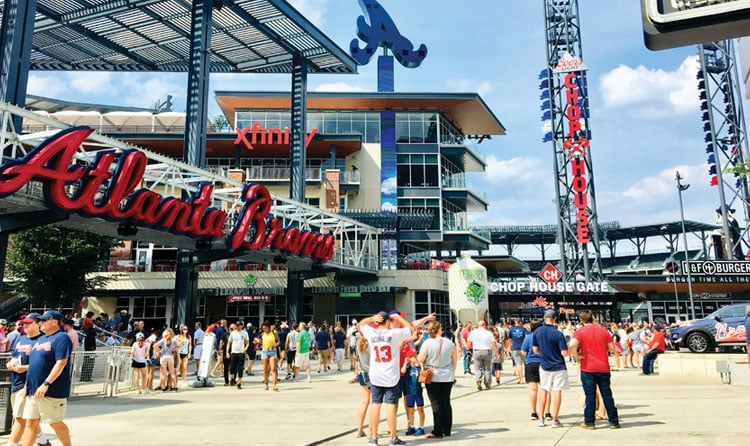
Truist Park — the home of the major league baseball team, the Atlanta Braves — and the adjoining 3-million-square-foot development known as The Battery Atlanta offer an advanced playbook for how to make mixed-use scenarios work. Integrated reservation systems, flexible staffing models, dynamic pricing, proactive traffic management, and real-time communications provide the payoff: dramatically enhanced customer experiences, maximized asset utilization, and optimized revenues that weather demand volatility.
Tailored success
The heart of a successful parking strategy involves identifying and thoroughly understanding user groups, including daily commuters, multifamily residents, retail shoppers, hospitality visitors, and event attendees. Each demands tailored parking solutions.
Commuters prize reliability and speed, benefiting from LPR or radio-frequency identification (RFID) solutions linked seamlessly to corporate systems. Residents prioritize security and consistency, demanding robust app-based management integrated directly with leasing platforms. Shoppers and visitors need intuitive, friction-free experiences — gateless parking supported by convenient validation options via merchant integrations. Event attendees require agile, reservation-based systems enhanced by dynamic pricing and instant occupancy feedback.
Validations, far from an afterthought, become strategic levers to build loyalty, incentivize spending, and smooth transactional friction. Digital validation platforms streamline merchant integrations and simplify user experience, but operators must guard against fraud and ensure accurate revenue tracking.
Human factors
Finally, an uncomfortable truth: Technology alone won’t solve every challenge. Non-tech-savvy users present an enduring challenge that must be effectively engaged to maximize revenue opportunities. Solutions range from expensive, traditional pay-on-foot kiosks to human ambassadors. The modern PARCS designer must accept these exceptions not as problems, but as crucial considerations in achieving universal accessibility and equity.
Ultimately, simplicity isn’t a starting point — it’s the destination. Achieving it demands that we first navigate through the complexity, understanding our users, contexts, and objectives profoundly.
Kevin Bopp is a principal at Revolve Partners and can be reached at [email protected]. Bernard Lee is a senior financial analyst at WSP and can be reached at [email protected]. Andrew Sachs is the president of Gateway Parking Services and an owner at Harbor Park Garage. He can be reached at [email protected].