


Better visibility through illuminated signage means more customers, fewer missed turns, and measurably higher parking revenue.
By Cliff Hoinowski
Imagine circling a downtown area, late for dinner reservations and struggling to find a parking spot. You accidentally pass the entrance to a parking garage because you didn’t see it in time, and the traffic behind you prevents you from backing up or turning around. Next, imagine leaving an evening outdoor sporting event, only to miss the exit and be stuck in traffic for an hour as you are directed to the next one. Finally, imagine a valet stand offering convenience during the busier evening hours of the holiday season, but customers don’t take advantage because they don’t know that this convenience is available.
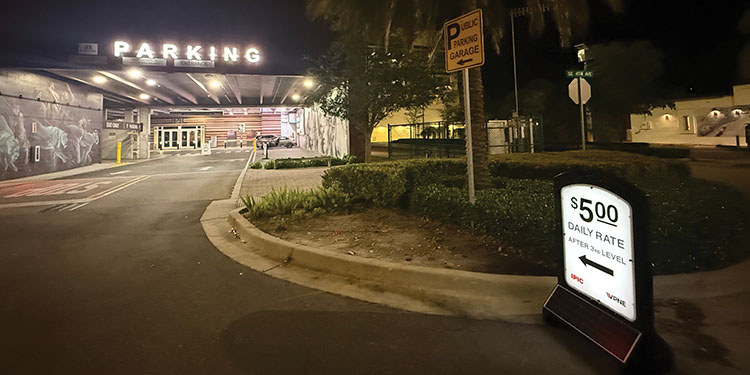
These scenarios highlight a persistent problem for parking operators and patrons alike — insufficient visibility at night. Now, imagine the same scenarios, but with a key difference: A brilliantly lit letter “P” guides you to the parking garage; an illuminated exit sign helps eliminate chaos during event egress; or a valet stand brilliantly advertises its convenience at night and helps lessen holiday traffic congestion while happy shoppers add to an operator’s profits.
With winter upon us, now is the time to reevaluate the evening visibility of your operations, whether the goal is increased revenue or the other benefits that come with improved visibility.
Signage is key
Seventy-six percent of consumers enter a business based on its signage alone, and 60% avoid establishments with missing signs, according to a 2012 survey conducted by FedEx Office in conjunction with Ketchum Global Research & Analytics. This is no different for parking.
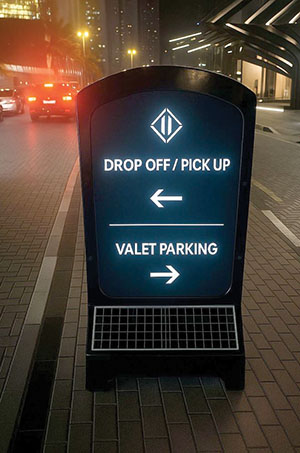
Although the parking sector traditionally has been slow to adopt new technologies, this trend has changed in recent years with the sector’s adoption of artificial intelligence, QR codes, automation, license plate recognition, mobile wallets, and dynamic pricing.
Even as the parking sector becomes more technologically advanced and sophisticated, all the conveniences and technological advancements in the world will not matter if parking operations fail to attract customers at the “door.” Customers cannot take advantage of the conveniences of an operation if they never become a patron of that operation to begin with.
If you build it, they will come
“If you build it, they will come” is a famous adage from the movie “Field of Dreams.” While it made for a memorable line within the movie, the saying has little applicability to the real world.
While Hollywood can create a scenario in which people travel from far and wide to visit an off-the-beaten-track ballpark within a remote cornfield, this is not the case for parking operations, not even in busy downtowns, never mind the middle of cornfields! If a sign cannot be seen, it serves no purpose whatsoever. Similarly, a non-illuminated sign at night is essentially invisible, negating its intended purpose.
Parking is a perishable commodity: If a space goes unfilled, there’s no second chance to capture lost revenue. In the high-stakes world of paid parking, visibility offers a golden ticket to bigger profits. Illuminated signs can grab attention like a beacon, reeling in drivers who might otherwise zoom past. A glowing sign saying, “Park Here! Scan QR Code!” doesn’t just guide — it sells.
With automation reducing on-site staff, illuminated signs are the ultimate wingman, streamlining payments and boosting throughput. A study by Point of Purchase Advertising International (POPAI) suggests signage can increase sales by as much as 30%, and the International Sign Association (ISA) found that 91% of shoppers believe signs influence their purchasing decisions. Within the same body of research, illuminated signage has been shown to increase overall sales volume by nearly 32%. These are no small numbers: In parking, that means more cars, more revenue, and happier operators!
Types of illuminated signs
Today, operators have three practical choices when it comes to selecting illuminated signs:
• hard-wired illuminated cabinets for permanent entrances and rate boards
• portable plug-in or battery units for construction phases, pilots, and seasonal peaks
• portable solar-powered units that deliver light anywhere you can roll them
All three have a role, and the right answer usually involves a combination of them across a network.
Hard-wired illuminated LED cabinets are best for permanent entrances, rate boards, lane IDs, and garage interiors to indicate where to pay, including signs with QR codes wherein the illumination prevents scammers from placing fraudulent QR codes over existing codes. Durable and bright, hard-wired illuminated LED cabinets can easily enhance the visibility of a parking asset and improve safety by eliminating customer confusion on tight bends, organizing traffic by directing patrons to open spots, and increasing revenue by improving visibility in self-parking and self-payment environments.
Portable AC-powered plug-in illuminated signs are useful for seasonal peaks, construction detours, pilots, and temporary zones. These signs offer such advantages as flexibility, fast staging, and ease of movement. Additionally, they are cost-efficient and work great for indoor use where AC power is readily available. Disadvantages include limited runtime and the need for routine charging of either the unit’s battery or the unit itself.
Solar-powered illuminated signs are a relatively new addition to the equation. What’s changed — quietly but decisively — is the maturity of solar. Smart controllers, high-efficiency panels, robust batteries, and weather-rated enclosures have moved solar from the category of “interesting” to dependable. In many deployments, solar units offer more reliability and functionality than AC-powered units and remain operational during power outages. Because they run on low-voltage DC, modern solar units are safe to operate around water and in crowded pedestrian zones. Many carry weather ratings suitable for year-round use, and the better systems include automated on/off operation, functioning on their own with no need for human intervention. Most importantly, they easily move with your operation — for example, out to overflow fields on Friday and back to a garage entrance on Monday — providing illumination where it can do the most good.
See it, choose it, enter cleanly
Illumination won’t fix every visibility challenge. However, it facilitates the first of the three key steps that parkers must take when selecting where to park: see it, choose it, enter cleanly. Treat illuminated signs as infrastructure, not décor. Specify them for increased visibility and place them where sightlines matter.
Finally, don’t hesitate to consider solar-powered illuminated signs. In 2026, solar power isn’t a novelty: It’s a practical, resilient way to illuminate precisely where you need light, exactly when it matters, and with the flexibility to keep pace as your operation changes.
As winter evenings stretch on and teams run leaner, illuminated signs often deliver the most tangible improvement per dollar: fewer missed turns, faster payments, calmer curbs, and revenue you can count at closing.
Cliff Hoinowski is the president and CEO of Sunsign, LLC. He can be reached at [email protected].