



Smart parking garage design creates flexible structures that free ground-level space for pedestrians while adapting to future mobility needs.
By Jason Rupp
When it comes to urban design, the question is not cars versus people. It is whether we waste the most valuable land on circulation and surface parking or concentrate vehicles into a structure that gives the ground back to daily life. Done right, the garage becomes urban infrastructure, supporting walkability, street-level activity, and electrified transportation without gambling on a single mobility forecast.
As architects and designers, we recognize that parking remains a requirement. However, when design begins with the principles it must operate within, parking does not have to become residual or inert space. When conceived deliberately, parking can function as a flexible structural framework that supports current leasing and entitlement realities while facilitating adaptation and long-term architectural value.
What follows is not theory. These are examples of the design moves that keep parking from becoming stranded and the project patterns that prove they work.
Reclaiming the roof as community terrain
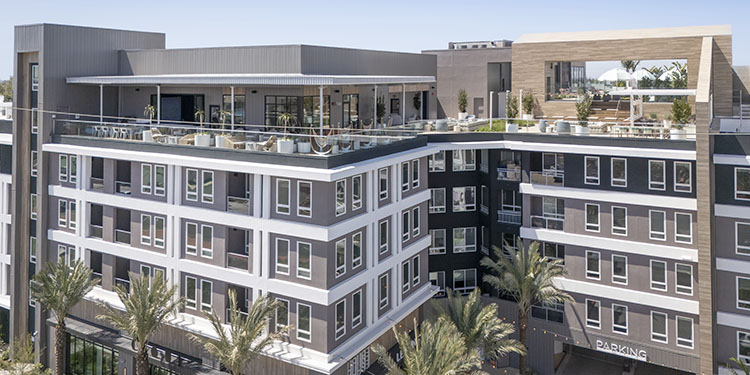
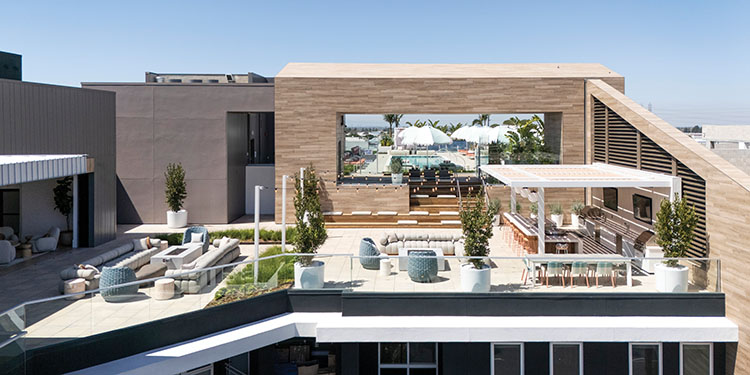
The takeaway is simple: The roof of a garage can provide the project’s primary social space, not leftover area. Cloud House — an apartment complex in Stanton, California —uses a five-story structured garage as the base for a 17,500 square foot rooftop amenity deck, including a pool, spa, terraces, fitness zones, and a community room with indoor and outdoor lounge space.
That move only works when the structure is designed for it from day one. Here, the parking levels are not just a parking frame; they are the amenity platform. Post-tensioned concrete flat plate construction supports the heavy loads and service demands that come with a pool and high-occupancy outdoor use. At the ground level, access is consolidated, and circulation is simplified, so pedestrians do not lose the site to drive aisles.
Electric mobility is treated as real infrastructure, not an afterthought, with 49 installed electric vehicle (EV) charging stations and planning that supports future expansion without ripping open finished construction.

Neighborhood scale mobility architecture
The takeaway here is that structured parking can organize a district while giving the ground back to people. An apartment community in Santa Ana, California, the Row at Red Hill spans 14.7 acres and delivers 1,100 residences and 80,000 square feet of retail, organized around four structured garages. Parking is not hidden, and it is not scattered. It is concentrated so the rest of the site can behave like a walkable neighborhood.
The project includes 2,458 stalls and 247 integrated EV chargers, acknowledging that the transition to electric works best when the infrastructure is reliable and convenient. By pushing vehicles into vertical structures, the design frees the ground plane for paseos, plazas, and open-air retail corridors instead of surface parking and ramp sprawl. Above, each garage roof becomes usable outdoor space, with pools, spas, and community facilities that function as social infrastructure, not decoration. The result is a district where parking supports value creation instead of consuming the best land and killing the pedestrian experience.
Building flexibility from the start
Mobility will keep shifting. What we drive, how we share vehicles, and how we charge will not sit still. That is exactly why garages should be designed for change, not built as single-purpose structures.
A few early decisions determine whether a garage serves only today’s requirements or is structured to accommodate future possibilities. Minimal slope decks and clear, rational grids make it easier to adapt bays into other uses later. Ramps can be designed so they are removable or concentrated, enabling future owners to reclaim floor area without demolishing the entire building. Heights between floors can be targeted in key zones, so conversion options remain realistic. Cores and egress can be located and sized with future occupancies in mind, so a later change does not trigger a full reset of the life safety approach.
The goal is not to predict the exact future use. It is to avoid locking the building into one outcome.
Infrastructure for the electric shift
Electrical and charging infrastructure follow the same logic: Plan for growth while the structure is open and accessible.
Start with electrical rooms sized for expansion, and distributed pathways, shafts, sleeves, and routing zones that enable power to reach future charging locations without invasive work. Plan conduit networks so future EV buildout becomes a controlled installation rather than a demolition project.
Design roofs with the capacity and attachment planning to support future solar, shade structures, or program upgrades without structural reinvention. In this way, a garage becomes a utility-ready chassis that can be upgraded over time.
Policy and the productive middle
EV requirements are tightening, and shared parking in multifamily and mixed-use projects is one of the most efficient places to deploy charging, because the same infrastructure serves many users during the life of the building. Apartments and districts cannot improvise later. Retrofits are expensive and disruptive. Getting it right up front creates a reliable home base for residents at night and a useful charging resource for employees and customers during the day.
This is the productive middle between two bad extremes: designing garages as permanent monuments to cars or pretending parking is disappearing fast enough to ignore it. The practical path is to build structured parking that is compact, integrated, and convertible. Such parking frees the ground plane, supports real programs above it, and carries the electrical backbone for electrified mobility.
When parking is treated as a flexible, utility-rich structure, rather than a dead zone, it can support density, walkability, and better ground-level places without serving only one approach to future mobility. The goal is not to design around parking. It is about creating a base where the next chapter of the neighborhood can take shape.
JASON RUPP is a partner at AO. He can be reached at [email protected].