
By Larson McDonagh
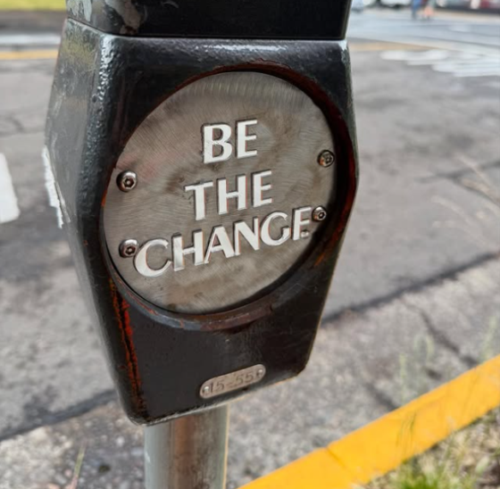
How would you decorate a five-inch diameter disc of space? In Eugene, Oregon, artists have used metal discs of this size to repurpose defunct parking meters around the city to deter littering and promote whimsy.
“One of the fun things to watch [is] other artists and how they participate,” said sculptor and artist Jud Turner, a Eugene resident who makes the discs and provides them to locals looking to create parking meter art. “For an artist, sometimes having self-imposed constraints breeds creative thinking. This is a five-inch disk that goes on to this meter space. And so, what do you do with five inches?”
Filling the void
In 2024, Eugene, Oregon, removed the coin vaults from its downtown single-space parking meters and converted them to accept credit-card payments only. The change came in response to chronic theft and vandalism of the meters, largely driven by the fentanyl crisis, said Jeff Petry, the curbside and administrative services director of Eugene’s Parking Services.
“It got to a peak where two-thirds [or] three-quarters of our meters were all in a vandalized state, from people trying to get to coins in the meters,” Petry said. “As soon as we…went to a credit card payment option only, the vandalism stopped immediately.”
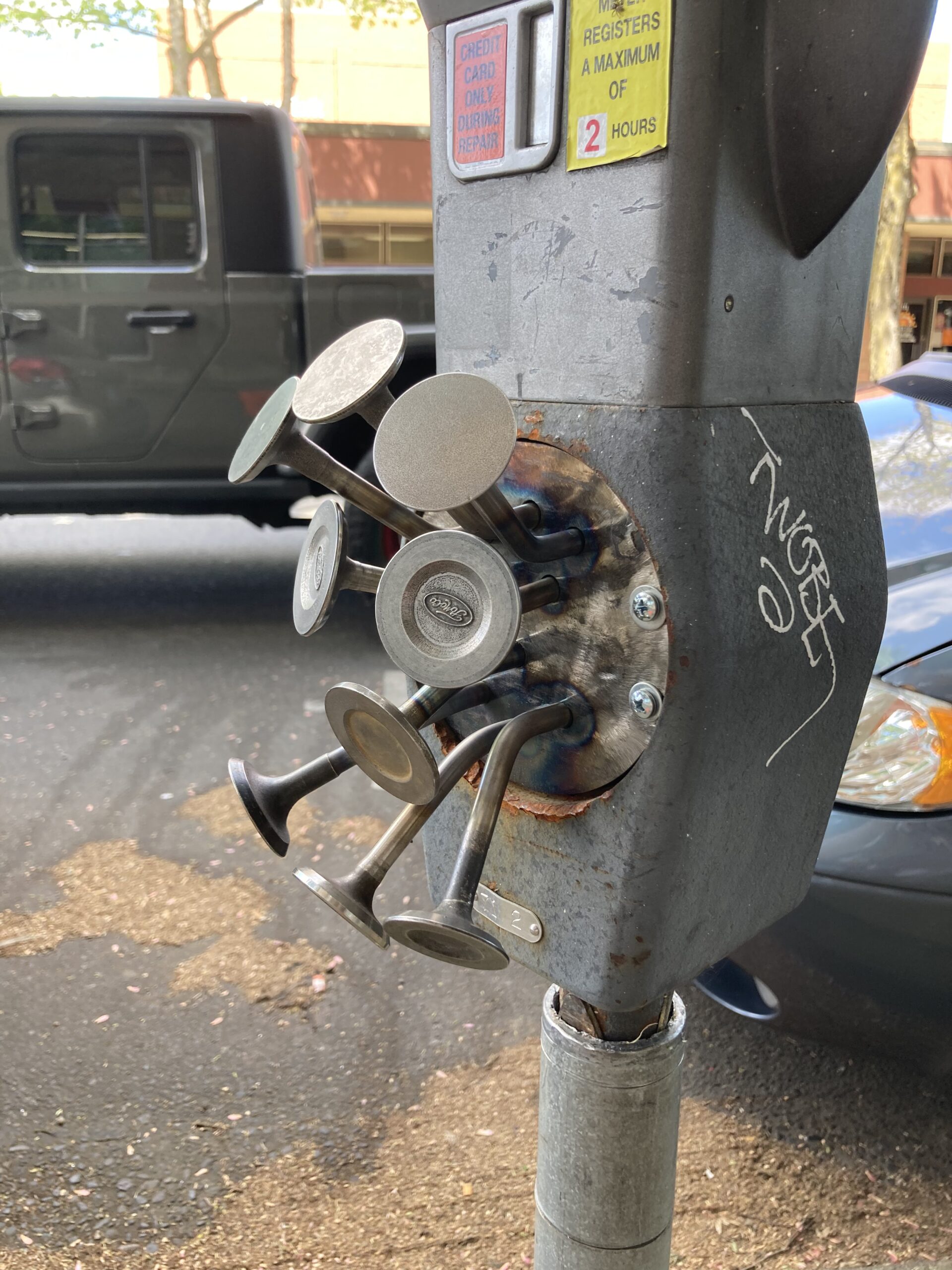
However, removing the coin vaults from the meters left a hole in the meter stands where the vaults originally operated. As a result, the parking meters began to fill with trash. Another Eugene resident, the retired-builder-turned artist Robert Bolman, began brainstorming ways to fill the space that would not only beautify the city but also send a message.
“I feel very strongly that this entire civilization thing we have going on is pretty unsustainable,” Bolman said. “I’m not a big fan of rampant automobile culture.” To give expression to his views, Bolman used car engine valves to depict an explosion and installed the artwork in the empty space within one of Eugene’s parking meters.
Many of Bolman’s sculptures reflect this worldview by using automobile parts, screws, circuit boards, and more. “I feel that a lot of my artwork has kind of an explosion quality, because I feel that this capitalism and civilization just sort of exploded all this stuff out into the world.”
Although Bolman’s first parking meter installation had to be taken down because it obstructed public walkways, the art piece sparked an explosion of creativity throughout the city, leading to hundreds of such installations in parking meters.
Letting guerilla art be guerilla art
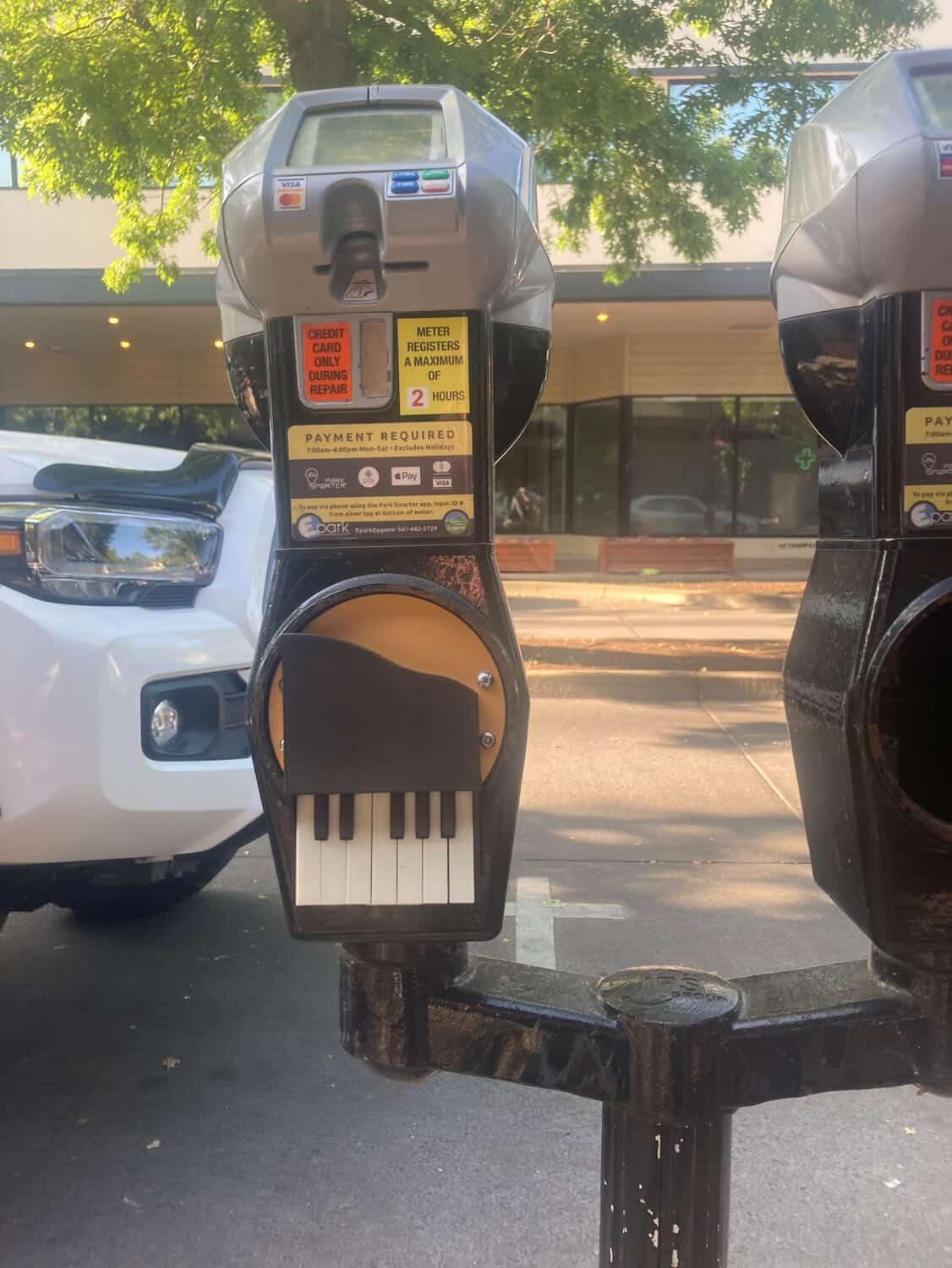
Public interest in decorating Eugene’s parking meters grew after Bolman shared his idea with fellow artist Turner, who began using his plasma CNC table to mass-produce circular five-inch discs with holes that could be attached to the coin vaults by screws. Given away to anyone wishing to use them to make art, the discs typically are painted, though some artists choose to incorporate wood, epoxy, and even 3D-printed items.
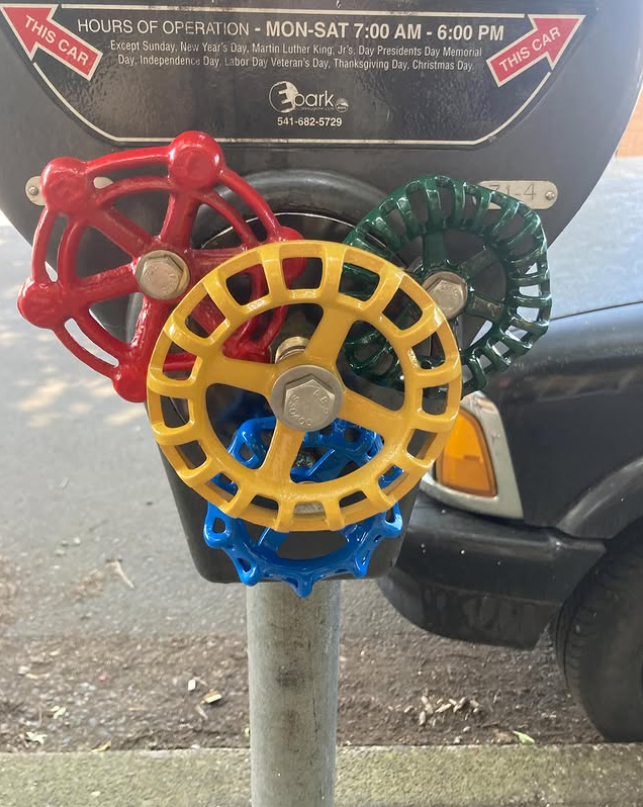
From the outset, Bolman and Turner decided against getting official permission from the city, assuming it would say no due to liability concerns. However, because the discs can be easily unscrewed and removed from parking meters, they decided to install their artwork and post photos of it on social media, making their identities known. Shortly after, Turner, Bolman, and their art were on the front page of Eugene’s newspaper, The Register Guard.
“If it creates some problem, it can be taken off, as the city has demonstrated that they’ll remove them,” Turner said. But outfitting the empty coin vaults with artwork benefits the city, he maintained. “It’s also blocking a hole that has been collecting garbage and cigarette butts and trash as people just pass by downtown. So, it’s sort of performing a low-level public service of closing this trash hole and putting art in its place.”
Although Eugene’s Parking Services is not involved with the parking meter art, it recognizes their value, Petry said. “Joy and meaning often come from public art being found in unexpected places as one goes about their day,” he said. “The discovery of art can be a fun, creative disruption that an artist interjects into the public realm. The creativity woven throughout our city’s built environment is one of the aspects that makes Eugene so vibrant.”
When supplying blank discs to those wanting to make parking meter art, Turner requests that they not make anything that protrudes into pedestrian walkways and avoid anything overtly offensive or political. This helps in keeping the art work in place, but he said there’s always a risk of removal or vandalism with street art. To memorialize the ephemeral pieces, Turner asks the artists to share photos of their work so he can post them to an Instagram account dedicated to the parking meter art.
The future of Eugene’s parking meters
With Eugene looking at options for replacing its existing parking meters, the mini art installations might disappear sooner rather than later.
Eugene Parking Services plans to pilot theft-deterrent single-space coin vaults in fall 2026. The city is also interested in incorporating multispace kiosks in the downtown area. Eugene has several kiosks located in off-street parking lots, primarily in the University district. The kiosks employ triple-security locks to deter vandalism. With either option, the city plans to implement on-street mobile parking payment options as well.
Turner and Bolman accept whatever may happen to the installations, given the impermanent nature of street art. Their motivation is simply to enhance the creativity and whimsy of “a great city for the arts and outdoors,” Eugene’s motto.
Until then, Turner and Bolman continue to work with Eugene residents to fill the empty slots where the coin vaults previously were. “Public art usually has a high bar for participation,” Turner said. “There are committees and funding and all sorts of hurdles involved. This removes all of that. It lets people put their artwork into public without any committee approval. They just go stick it up.”
Larson McDonagh is a freelance environmental journalist based in Shoreline, Washington. They can be reached at [email protected].