

Mary S. Smith’s induction into the Parking Hall of Fame caps a 50-year career that has taken her from the suburbs of Chicago to theme parks on two coasts, the deserts of the Middle East, and the pages of the industry’s most widely used reference books.
By Jay Landers
When the inaugural class of the Parking Hall of Fame was inducted in late March 2026, Mary S. Smith, a senior vice president for Walker Consultants, was among the 12 honorees. The event was one of the most meaningful recognitions of her distinguished career as a parking designer. “To be part of the first twelve, out of a hundred years of parking, just really meant a lot to me,” Smith said.
The honor is fitting. Smith is the only person to have received both the International Parking and Mobility Institute’s Lifetime Achievement Award (2018) and the National Parking Association’s Harwood Leadership and Legends Award (2020). She has been the primary functional designer for at least 20 structures with 5,000 spaces or more, written the industry’s most widely used textbooks, and done all of it at Walker Consultants for more than 50 years.
Origin story
Smith grew up in Elgin, Illinois. When she was nine, her parents built a vacation house, and she became fascinated with interior layouts. Through high school, her hobby was finding a house exterior she liked in a magazine and redesigning the floor plan. “I was always into the layout part of it,” Smith said.
But the sexism of the day kept her from pursuing her passion at school. “I was the last girl denied permission to take mechanical drafting,” she said. “Two years later, they let somebody do it.” Despite this hurdle, Smith’s interest in layout and design would have a formative influence on her career.
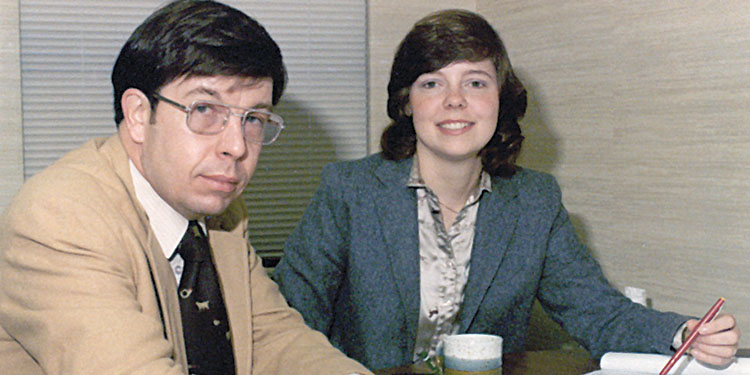
As an undergraduate at Purdue University during the early 1970s, Smith pursued an interdisciplinary program focused on architectural engineering. After graduating, she applied to Walker, which had an office in Elgin. Her earliest mentor, Tony Chrest, knew her professors and went to bat for her. Walker hired her in November 1975 as a project engineer, even though the owner of the company at the time advised against it, on the grounds that she likely would quit to have children within a year or two. “Fifty years later, here I am,” she said.
Leadership quickly recognized she could write better than the average engineer and had an instinctive feel for parking layout, and she moved into functional design, figuring out how cars and people move through structures. “It was the perfect niche for me,” Smith said.
Publishing and research
Smith’s research career began in 1979, when her boss, Frank Transue, driving back from a zoning hearing, said he was tired of citing an outdated 1970 reference on car sizing. A week later, Smith handed him a proposal for a rational methodology to determine stall and aisle dimensions as car sizes changed. Borrowing from traffic engineering, Smith developed a level of service framework that applied letter grades to all aspects of parking functional design, including stall dimensions, aisle widths, turning radii, ramp slopes, clear heights, walking distances, and lighting. It gave designers and clients a shared language for balancing user comfort against construction economics.
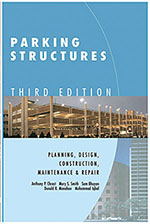
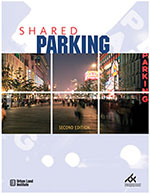
Walker was later asked to write a comprehensive textbook on parking structures; Smith authored all functional design content. Titled “Parking Structures: Planning, Design, Construction, Maintenance, and Repair,” the book ran through three editions (1989, 1996, and 2001). She also wrote the second and third editions of the book “Shared Parking,” which were published in 2003 and 2017, respectively, and contributed chapters to two transportation engineering handbooks.
When the U.S. Access Board issued its first draft Americans with Disabilities Act standards for accessible parking in 1991, Smith spent months studying the implications. She traveled to Washington, D.C., to meet with the Access Board, and published guidance for the parking industry, a role she has reprised with every subsequent update.
Speed parking and the world
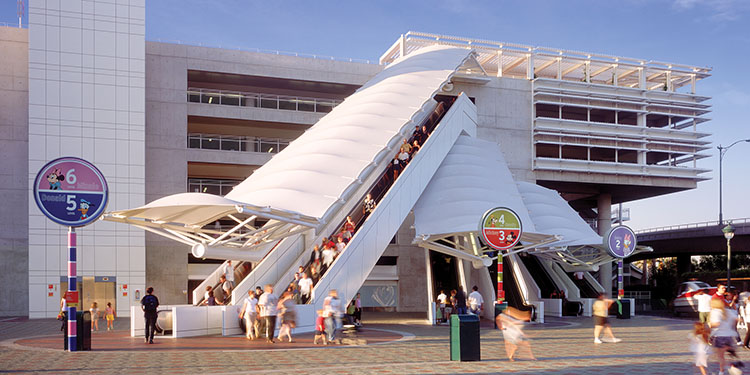
In 1991, the Walt Disney Company issued a request for proposals for its first large parking structure at Disneyland, in Anaheim, California. Walker won the deal to design the roughly 10,000-space facility, and Smith worked out of Disney’s California offices for six months. Although the project was later paused, Smith got another chance to develop the functional design of two 10,000-space parking structures when Universal Studios hired Walker’s team for its theme park Universal Studios Florida, in Orlando. The first deck opened in 1996.
When it did, Universal had fewer lost cars than it had in its previous 10,000-space surface lot, a result Smith attributes to the wayfinding Walker designed as part of the structure. “That was one of the achievements that I’m very proud of,” Smith said.
The core challenge at both parks involved speed parking, meaning the ability to park as many as one car per second in a 10,000-space deck while moving more than 10,000 guests per hour and separating pedestrians from vehicles, something that had never been done in a parking structure before. When Disney eventually moved forward with its parking structure at Disneyland, internal opinion was divided on whether to rehire Walker, after it had worked with its competitor. According to a story reported to Smith, Disney CEO Michael Eisner visited Universal Florida, stood on the top deck of the parking structure, and told his staff, “Hire them.” “That’s probably one of my favorite stories for my whole career,” Smith said.
Smith’s career in parking has taken her around the world. She worked on parking facilities for the Japanese theme park Tokyo Disney Sea, the Chinese theme park Universal Beijing, and a Middle East project with a master plan encompassing 30,000 spaces under a single podium. Elsewhere in the Middle East, Smith worked on the design of a six-story 26-block underground parking facility constructed as part of the Msheireb Downtown Doha, a planned new downtown in Doha, Qatar. In 2012, Smith spent six months in Abu Dhabi, the capital city of United Arab Emirates, training new staff hired to open Walker’s office there.
Trends and what’s next
As she looks back at her career, Smith identifies the late 1980s as the turning point when the industry shifted from thinking only about cars to thinking about people, “because a lot of people are in the parking garage longer as a pedestrian than they are as a driver,” she noted. That shift elevated wayfinding, safety, and lighting as priorities, and drove the industry away from double-threaded helixes toward flat-floor designs with dedicated express ramps.
More recently, Smith has focused on autonomous vehicle (AV) technology and electric vehicle (EV) charging. She was an early skeptic of the circa-2015 prediction that shared mobility would all but eliminate private vehicle ownership within a decade. In 2017, she developed a model projecting AV impact on parking demand by projecting vehicles on the road rather than just sales; her current projections show that even in a high-disruption scenario, demand would fall to roughly 75% of 2015 levels by mid-century, far from the 10% some had predicted.
Smith officially retired from Walker about two-and-a-half years ago and moved to a contract arrangement at about 20 hours a week, enough to keep working on what she loves, including helping to design three major airport garages this past year. After 50 years, the work remains fulfilling. “It’s fun,” she said. “I just love laying out parking decks!”
JAY LANDERS is the editor-in-chief of Parking Today. He can be reached at [email protected].