



By Kevin Uhlenhaker
Editor’s Note: The article is the first in a new series of conversations with the founders who built this industry.
This is the first installment of a new series we are calling Founder Stories. The premise is simple: discussions with the people who built the companies that define our industry. The actual founding story, the near-death moments, the pivots, the regrets, and the lessons they would pass along to someone thinking about starting a company in the parking industry today. I am going to sit down with as many of them as I can to enable them to tell their stories and share their wisdom.
I started with Juan Rodriguez, co-founder of Flash. We sat down in Austin, just a few miles from where Flash began in 2011.
If you are looking for the one thing that made Flash work, here it is: Juan paid attention to feedback. He listened to a dinner table complaint, he watched a 70-year-old woman send a text message at a restaurant, and he responded to customer after customer describe the same broken hardware story until he could not ignore it any longer. The product changed more than once. The discipline of paying attention to what customers actually said did not.

first official logo, right, created by Chelsea McCullough in September 2011.
The complaint that became a company
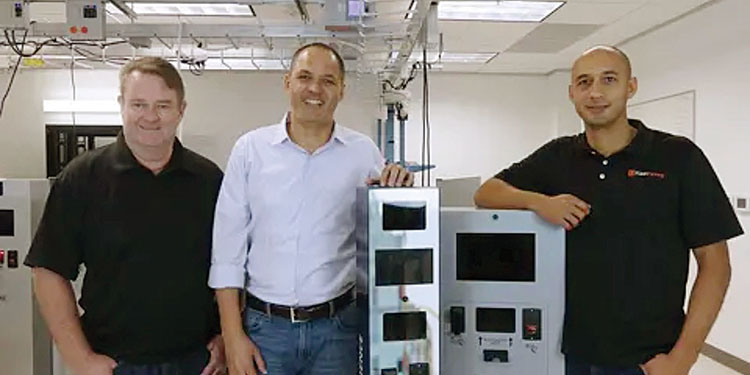
When Juan and his co-founders Eliseo Diaz and Dean Cleaver were figuring out what to build next, parking was nowhere on the list. They had four ideas they were planning to put in front of potential investors and were searching for a fifth, mostly to round out the pitch.
His journey into the parking industry started with Eliseo’s wife, Daniela. Daniela worked for a company that served hotels, which meant she used valet parking about 15 times a day. Every time the three of them got together, she told the same story. Five minutes upstairs with the hotel general manager, then 15 minutes downstairs waiting for her car at the valet. To make it worse, the valets only took cash, so she had to use an ATM, with surcharges and bank fees on top of the parking fee and tip. The time and the money made her crazy.
“Why can’t you just build a system where I can pay and tip and request my car from my phone?” she kept asking. Juan, by his own admission, laughed her off for months. He and Eliseo were working on systems transferring money between U.S. banks and Brazilian prepaid cards. Parking downstairs was the last problem they thought was worth spending their time to fix.
But eventually, they started timing valet parking interactions. Seventeen minutes at a hospital. Twenty minutes at a restaurant. Juan finally went to Dean and said let’s build it as the fifth idea, just to see. They put it in front of about a dozen people. Every single one of them said the same thing: Fix that problem. Every single one of them noted there was no competition, because it seemed nobody was investing in parking technology innovation at the time.
That fifth idea was the start of what became Flash.
The first customer
Corey Evers, the founder of Central Texas Valet, has been a leader in the Austin, Texas, valet market for many years. Juan told me that Corey was the first Flash customer, and the first transaction was processed on a Nokia flip phone with no app and no user interface.
The first version of the system relied on text messaging. The customer would text the number on the valet ticket and the valet would type a “one” back into Google Talk to accept the car request. No iPhones were used in the original Flash deployment. Juan spent opening night at a seafood restaurant downtown, watching every car come in, half convinced no one would actually use the new system.
The first text came from a woman in her seventies who had finished dinner around 6:15 p.m. She sent her vehicle request from a flip phone. Her car was waiting when she walked out, and the woman told Juan that her mind was blown. So was his. That was the moment he knew Flash had something real.
“I am always grateful for the operators who take that kind of risk,” Juan said. Corey could have said no and nothing in his business would have changed. He had every restaurant in downtown Austin. The status quo was working. He said yes because he could see where the industry was going. As Juan recalled, “You cannot do this unless customers can see the future.”
The pivot the board did not want
Juan’s first definition of success was modest. Fifteen employees, a cash-flowing profitable business, and an exit to the online restaurant-reservation service company OpenTable if they got lucky.
What changed everything was, again, the listening. As Flash grew on the valet side, Juan started running quarterly check-ins with customers around the country. He told me five minutes of each meeting was supposed to cover the Flash roadmap. The other 55 minutes almost always became what he calls a therapy session. Customers wanted to talk about the access and revenue control side of their business. The $50,000 Payment Card Industry Data Security Standard upgrades. The $4,700 ticket spitters. The $350 service calls just to change a rate, plus another $350 to change it back the next week. The Houston customer whose on-premise server rack got knocked offline for two weeks after a contractor spilled a Coke on top of it.
Juan heard similar stories in every city. He went back to his board and asked their thoughts about Flash seeking to solve the problem with parking access and revenue control system (PARCS) technology. The board was not excited about the idea, and their logic was sound: Flash was nearly cash-flow positive. Most startups never get to that point. Why risk it?
Juan drew up the new product anyway. Cloud-based instead of local servers. An emergency parts kit instead of waiting for a service truck. Off-the-shelf components using USB connections, so an operator could swap them themselves. Then he showed the design to customers, with pricing, and asked flat-out whether they would write a check. They told him he would be stupid not to build it. Juan went back to the board with those answers, found new supporters, and eventually, the members who had been against the move came around. Flash built a PARCS product that the operators of the day could not find anywhere else.
He is clear that he does not consider PARCS a real pivot. The valet business kept running. He calls it an addition. But every piece of it came from letting customers talk beyond the set agenda.
Advice for the next generation
I asked Juan what he would tell someone thinking about starting a parking company today. His answer was not romantic.
“Do not follow your passion,” he said. He thinks the people who like to say that are already rich. Go find an actual problem and prove it with people who will write a check. “Would you buy this?” gets you nothing useful. Ask about price. Ask if it goes in their budget. Ask if they will fight for it internally. If the answer is, “I would have to ask my boss,” you do not have a real customer.
“Build a team that you enjoy working with and that can do what you cannot,” Juan said. He picked Eliseo because he could open and close deals without ever sounding like a salesperson, and Dean because he could ship the work of a team of engineers overnight from New Zealand. For 15 years, Juan spent more hours with his founders than with anyone else on the planet.
Finally, “Do it young,” Juan said, before the cost of those hours can be measured in missed birthdays, weddings, and school performances. Juan was candid about that part: the financial stress, the physical stress, the high-blood-pressure medication he is convinced started with Flash, and the family time that does not come back. He knew he’d have to pay a toll. But he was surprised by the size of it.
What’s next
I asked Juan what comes next. He told me he is going to try to make up some of that lost family time, and then sit on a beach and study the slope of a wave. He also told me he plans to work until the day he dies. Both, somehow, can be true.
For an industry full of operators and would-be founders who think they cannot build something new, because the incumbents are too entrenched or the buyers move too slowly, Juan’s story is the right one to start this series with. The incumbents are entrenched. The buyers do move slowly. Flash got built anyway, because three people in Austin decided to keep asking customers what hurt and to keep paying attention to the answer.
KEVIN UHLENHAKER is the CEO and publisher of Parking Today Media. He can be reached at [email protected].