

A groundbreaking study of parking customers across the U.S. and Canada shows that parkers still prefer traditional payment methods despite the push toward digital solutions.
By Art Alabin
Editor’s note: This article is based on a presentation conducted by the author during Parking Today Media’s 25th Parking Industry Expo held this past spring in Schaumburg, Illinois.
The ability to find and retain parking customers requires an intimate understanding of their needs. In my 29 years in parking — first as an operator, then as an auditor, and then ultimately as a researcher — I have never seen any independent studies of U.S. parking customers. Despite the absence of such studies, I have seen many equipment companies and parking operators make decisions based on profit margins in the hope that the necessity of parking would yield favorable results.
This research gap has left the parking industry operating largely on assumptions rather than data-driven insights. Without comprehensive demographic surveys or customer behavior studies, operators have relied on anecdotal evidence and industry conventions to shape their pricing strategies, technology investments, and service offerings. The result has been a disconnect between what parking providers think customers want and what customers actually value.
Our recent survey of 3,000 parkers across the United States and Canada represents a significant step toward filling that knowledge void, offering operators their first comprehensive look at customer preferences, pain points, and expectations that can inform more strategic decision-making and ultimately drive both customer satisfaction and operational success.
Who we surveyed
I hope that our research — the first of its kind — is useful to realize some basic principles of the customer experience. Many articles in parking magazines focus on understanding customer behavior, engagement, and experience in the relentless pursuit of quality service and customer satisfaction. Why? Because happy customers return to your business, creating endless potential for producing revenue.
Servimer — which provides mystery shopping services for parking operations and other businesses — took the first step toward understanding what parking customers in North America truly want. We did this by surveying thousands of our mystery shopper subcontractors located across the continent, asking them about payment preferences and the factors that inform their decisions regarding where to park.
Conducted in February and March of 2025, the study sampled approximately 3,000 respondents from all walks of life across the continental U.S., Canada, Puerto Rico, and Hawaii.
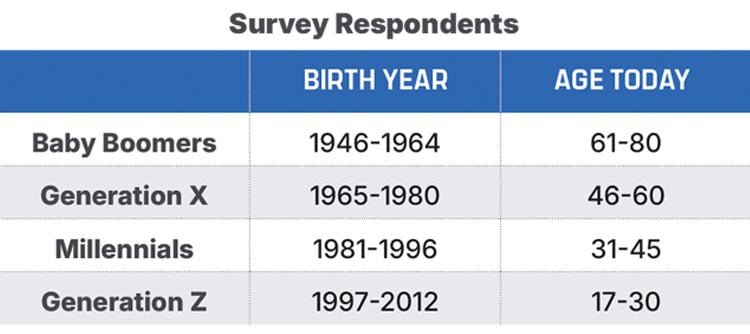
Among the respondents, 72% were women and 28% were men. Respondents were separated by age into their respective generations: Baby Boomers, Gen X, Millennials, and Gen Z (see below).
The respondents included various professions, families with and without children, married couples and singles, workers, students and retirees, and professionals with income that ranged from $20,000 to more than $250,000 per year. With just one exception, no parking employees were included.
The questions in the survey were generic and did not require respondents to explain why they thought or felt a certain way. The study was designed to avoid biased responses, such as prioritizing one response over another.
Payment preferences revealed
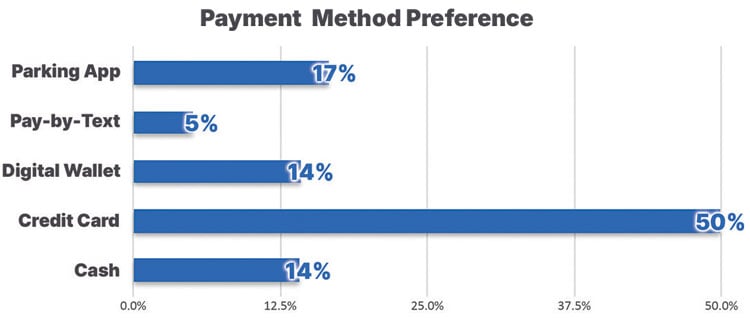
For the first question, survey participants were asked if they would prefer to pay for parking using a parking app, pay-by-text, digital wallet, credit card, or cash. It turned out that the vast majority of customers, approximately 50%, still prefer to pay using a physical credit card (see related chart for Question 1). This is the case even though parking apps and pay-by-text are the most secure forms of payment and despite the fact that all the options besides cash imply payment through a credit card.
The second most popular payment method, at 17%, was by parking app, followed closely by digital wallet and cash, both of which were the preferred method for 14% of respondents. Pay-by-text, the last-place option, was the preferred method for only 5% of respondents.
Question #1: If all of the following options were available at a parking facility, which method would you use to pay for your parking?
Recently, one of our subcontractors visited a parking facility in Nashville, Tennessee, that had two options of payment: scan-to-pay via app and a pay station that enables patrons to pay by the space and display a printed ticket on their vehicle. The subcontractor paid by credit card using the pay station to obtain the ticket for her vehicle.
When asked why the scan-to-pay option was not used, the contractor responded that she chose the “older” equipment because she was familiar with it, and so the pay station was simpler and faster to pay for parking. (The results of the survey’s second question, discussed below, shed more light on why the customer chose the pay station as an option.)
As the example of this particular customer illustrates, parking operators looking to implement new payment equipment may want to consider the option of implementing hybrid solutions that enable the use of apps and credit card systems for payments.
How customers want to pay
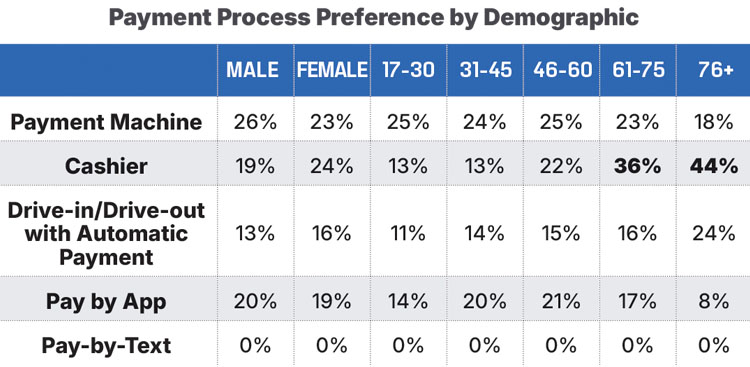
For the second question, survey participants were given a slightly different set of payment options from which to choose as their preferred method: drive in and drive out with automatic payment, parking app, payment machine, pay-by-text, and cashier (see related chart for Question 2).
Although payment machine was the top choice for 30% of respondents, the cashier option came in second place, with 25% of respondents selecting it. Cashier barely beat out parking app (24%) but came in several percentage points ahead of drive in and drive out with automatic payment (21%). Notably, the pay-by-text option was not chosen as a preferred payment method by any parker category.
Question #2: From among the following options, what is your preferred process of paying for parking?

When the ages of respondents are taken into consideration, the strong preference for the cashier option reflects the leanings of the aging Baby Boomers, who represented 30% of drivers in the U.S. as of 2025 (see the related table, which reflects the responses according to gender and age group).
Although a relatively new development in the parking industry, the option to drive in and drive out with automatic payment appears to be catching on with the public. According to the Law of Diffusion of Innovation, mass acceptance of an idea or product cannot occur until it reaches a tipping point between 15% and 18% of market penetration. With about 250 million drivers in the U.S., the option to drive in and drive out with automatic payment has worked well and been used by 38 million customers, leading to mass adoption of the payment method.
Men and women park differently
Question #3: If you had to park downtown in a city, what would be your consideration for choosing where to park?
When I entered the parking industry in 1996, my managers often told me that parking is driven by price. Back then, a difference of $0.25 or $0.50 in the daily rate between you and your competitor across the street could result in the loss of your customer. On the surface, nothing has changed 30 years later. Price remains the primary factor for parkers when deciding where to park (see below).
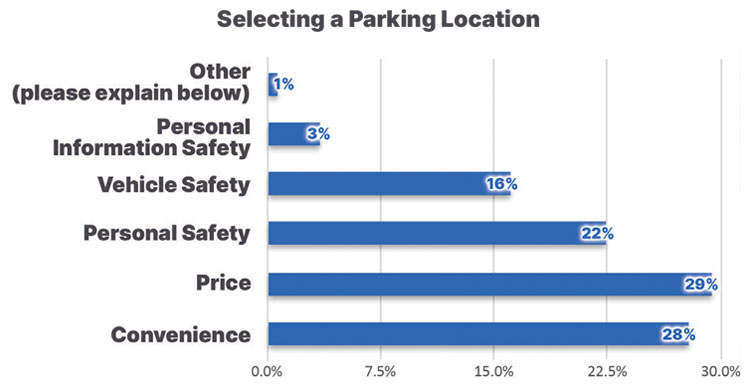
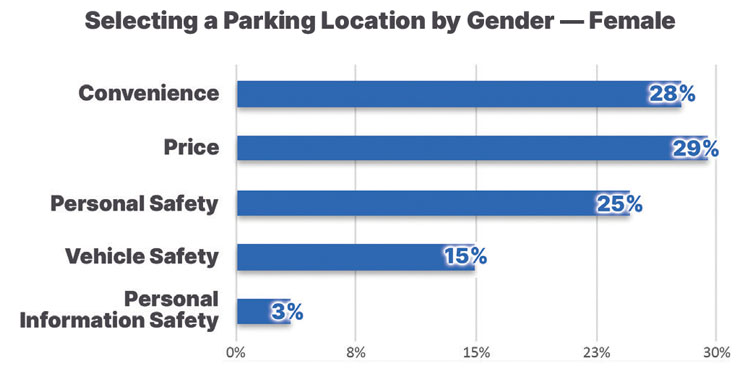
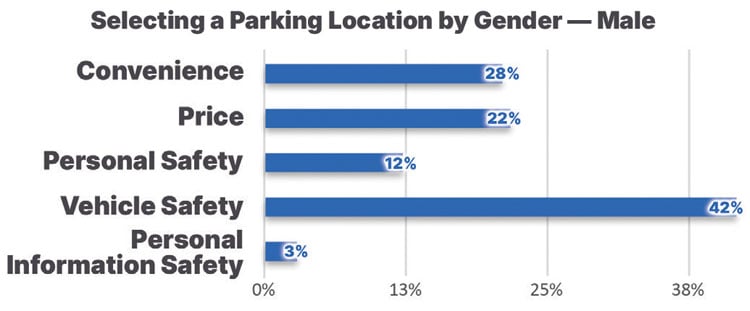
However, a more complex picture emerges when the variables of gender and age are considered. By digging deeper into the survey responses, our team discovered revealing motivators: Women are mostly concerned with price, convenience, and personal safety, while men are mostly concerned with vehicle safety followed by price and convenience (see related charts for female and male responses).
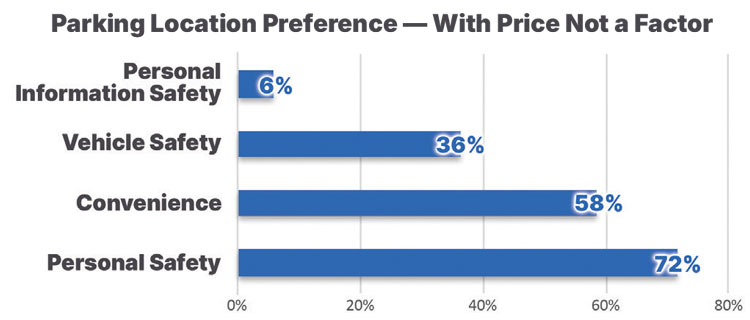
Perhaps surprisingly, 38% of the respondents did not care about the price of parking, a response held equally among males and females. Unsurprisingly, Baby Boomers and Generation X — statistically the wealthiest generations in the U.S. — top the charts in terms of those customers who do not care about price.
You may ask, if not price, then what? As shown by the related chart, personal safety, convenience, vehicle safety, and the safety of personal information were the main considerations other than price.
Win-win solutions
The research showed some unique results regarding how to appeal to different generations of drivers as well as to different genders. Relying on these results, parking providers can use a combination of factors to increase revenue.
For example, we learned that Baby Boomers prefer to use a cashier and pay by credit card, and they are concerned with personal safety. In cities and communities with the most retirees, a parking provider can place an attendant or add security personnel in the facility to address safety concerns, add a credit card payment option, and then increase the parking rate to cover the increased expense and ensure a location’s profitability.
No single solution to ensure customer satisfaction exists, because we are all different. Some parkers appreciate speed of service, while others prefer such factors as accuracy of the transaction, personal and vehicle safety, or lower price.
The survey results offer deeper insight into the preferences of parkers of different ages and genders. Armed with these findings, parking providers can consider multiple, varied “win-win” combinations of payment options and other factors that appeal to various target demographics. Making such changes can help them remain in business and stay competitive, profitable, and successful.
Art Alabin is the CEO of Servimer. He can be reached at [email protected].