


Strategic loading zone programs generate revenue while supporting local businesses and reducing traffic congestion.
By Nan Chen
Cities across America face a growing challenge: balancing the urgent need for loading zones with protecting valuable parking revenue. The demand for dedicated loading space has escalated dramatically as people increasingly rely on delivery and ride-hailing services.
This growth is staggering. In 2018, the U.S. online food delivery market was valued at approximately $17.5 billion, according to the data and business intelligence platform Statista. By 2024, this figure had surged to an estimated $353.3 billion — an astonishing increase of 1,920% in six years. Grocery deliveries alone generated around $257 billion in revenue in 2024, accounting for nearly two-thirds of the total market, while meal delivery contributed approximately $96 billion in revenue.
Successful curb management requires recognizing that loading zones and parking spaces are complementary components of an integrated strategy, not competing resources. Cities that understand this relationship and properly value the economic and social benefits of well-designed loading zones can create solutions that serve commercial needs while maintaining revenue streams.
Loading zones and parking trade-offs
Loading zones serve two primary functions:
• Commercial loading zones provide dedicated space for commercial vehicles to load and unload goods.
• Passenger loading zones facilitate pickup and drop-off for ride-hailing services and personal vehicles.
Both types reduce congestion on streets and sidewalks, lead to faster turnaround times, improve overall logistics operations, and help prevent double parking and illegal stops that obstruct traffic flow and create safety hazards. This improves overall safety for both drivers and pedestrians.
Currently, most municipalities charge a minimum fee for commercial vehicle curb access or have no fee. Understanding the relationship between loading zones and on-street parking and recognizing the market and social value of loading zones is essential for effective urban planning.
Loading zones create a fundamental tension in urban planning. The need for these zones varies based on land use and the number of businesses, making placement a dynamic consideration. Several factors influence their size and location, but they often compete directly with regular on-street parking spaces.
This competition has real financial implications. An on-street parking space can generate thousands of dollars annually in revenue for local businesses and governments. Although most municipalities require loading zones in their zoning ordinances, these zones are typically reserved for commercial vehicles or those with pre-approved permits to minimize disruptions to traffic flow and pedestrian safety. They are not shared with vehicles providing food deliveries, e-commerce deliveries, or rideshare pick-up and drop-off activities.
Most municipalities allow local businesses to request new loading zones. For example, parking authorities typically provide online loading zone application forms that local businesses can use to submit establishment requests. The city and parking authority then evaluate and decide whether to approve the application.
Multiple factors can lead to denials of loading zone requests: traffic and safety concerns, municipal policy limits, parking meter revenue losses, and inconsistency with long-term planning goals.
Enforcement challenges
On-street parking enforcement is usually handled by city parking or police departments. In cities with high parking demand or those not prioritizing parking enforcement, sufficient parking enforcement officers may not be available to monitor and ticket all illegal parking. This leads to under-enforcement and non-compliance in loading zones.
Drivers may disregard loading zone regulations due to convenience, lack of perceived risk of being caught, or misunderstanding of the rules — all factors that reduce enforcement effectiveness. Although technology like license plate recognition and sensors can help with enforcement, they require significant investment and may not be effective in all situations, such as areas with high pedestrian traffic or frequent vehicle turnover.
Maximize benefits and increase revenue
Successfully managing loading zones requires a strategic approach that balances operational needs with revenue protection. The following strategies can help municipalities optimize their curb space while supporting local businesses.
Commercial and passenger loading zones significantly support local businesses and reduce traffic congestion. They facilitate efficient loading and unloading of goods, services, and people, an essential outcome for businesses to operate effectively, especially in areas with high commercial activity.
Accessible loading zones improve the efficiency of local businesses, enabling timely deliveries and pickups. This leads to better customer service and potentially higher business productivity. Designating specific passenger loading and unloading areas reduces congestion caused by delivery or ride-hailing vehicles stopping in traffic lanes, helping maintain smoother traffic flow and reducing accident risk.
Visibly marked loading zones help reduce illegal parking in commercial areas by providing commercial vehicles with designated spots for their activities.
Strategic placement
Commercial loading zones should be strategically located near business entrances, particularly for retail stores, restaurants, and other commercial establishments that frequently receive deliveries. Proximity to entrances minimizes the distance goods need to be moved, reducing both time and effort for delivery personnel.
Ideally, these zones should enable delivery vehicles to easily access and exit without obstructing traffic flow, making locations alongside streets or alleys highly suitable.
Passenger loading zones should be positioned near or at the front of residential complexes or hotel entrances, which typically generate ride-hailing pick-up and drop-off activities.
To ensure safe, efficient operations, loading zones must not interfere with pedestrian pathways or high-traffic areas. They should avoid blocking access to sidewalks, crosswalks, or building entrances, preserving clear and safe pedestrian routes.
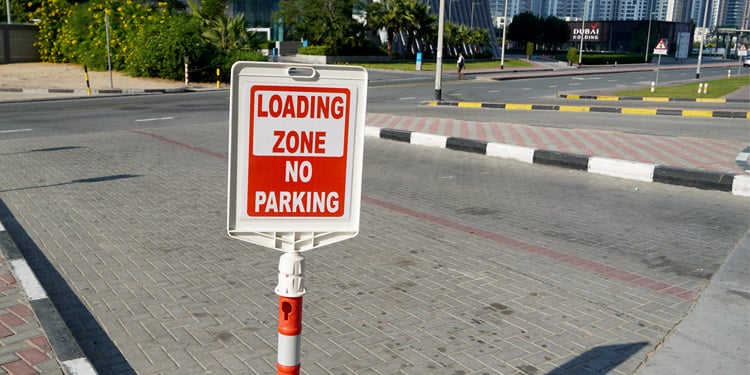
To prevent misuse and ensure delivery availability, commercial loading zones should be marked with signage specifying their purpose and any applicable time restrictions.
Enable zone sharing among multiple businesses
In urban areas with limited space, dedicating loading zones exclusively to individual businesses is often inefficient and underutilizes valuable curb space. Allowing multiple businesses to share a single loading zone can maximize efficiency while meeting diverse community needs.
Municipalities can support various activities by strategically locating shared commercial and passenger loading zones for multiple nearby businesses, including deliveries, pick-ups, and drop-offs. This approach ensures better curb utilization while reducing demand for additional loading zones that compete with on-street parking.
Local governments can implement permit or scheduling systems to facilitate this approach, ensuring equitable access to shared loading zones among businesses. For example, businesses can reserve time slots or use app-based tools to coordinate usage, minimizing conflicts and enhancing reliability for commercial vehicle operators.
Shared loading zones also benefit local economies by maintaining access to e-commerce deliveries, food service logistics, and rideshare activities without displacing on-street parking spaces that generate significant revenue for businesses and municipalities. Additionally, this approach encourages better collaboration among businesses and promotes a more adaptable urban transportation network.
Employ strategic time restrictions
Implementing well-defined time restrictions and limitations is essential to enhancing the effectiveness of on-street loading zones. By establishing designated hours for loading and unloading activities, businesses can rely on these spaces when most needed, such as during peak delivery times or specific business hours. This ensures loading zones are utilized efficiently and remain available for commercial needs without risk of congestion from unauthorized vehicles.
Setting clear time limitations ensures that loading zones do not remain occupied unnecessarily, maximizing the utility of these spaces and enabling businesses to operate smoothly. Clear time restrictions and limitations help prevent unauthorized use of loading zones, improving compliance with regulations and reducing enforcement challenges.
Implement smart loading zones
Several cities across the United States have successfully implemented smart loading zone programs, leveraging advanced technology to monitor and manage loading zone utilization more effectively. These programs typically involve sensors, cameras, and data analytics to track when and how loading zones are used, providing real-time information on vehicle occupancy and duration of stay. By integrating these technologies, cities can more accurately assess demand, ensuring loading zones are available for commercial use when needed and preventing misuse by unauthorized vehicles.
Smart loading zones utilize innovative digital camera technology and gather data that stakeholders can leverage to enhance loading zone efficiency, boost revenues, and improve safety for various curb space users. This technology presents numerous opportunities to achieve these goals, including data collection and analysis, automated billing, and enforcement.
Cities and parking organizations gain access to comprehensive loading zone data, enabling them to analyze patterns and develop policies to increase turnover, reduce carbon emissions, and enhance safety on streets and sidewalks. A customizable dashboard enables cities to tailor data to their specific needs. Additionally, parking organizations can use smart loading zones as invoicing tools for loading zone patrons based on actual usage, simplifying payment processes for commercial fleets and businesses.
Camera technology also enables cities or parking organizations to record all loading zone activity in real time, notifying parking organizations of violations and alerting enforcement staff accordingly. Parking organizations can monitor violations anytime, enabling them to identify unusual or inefficient patterns and implement policies to improve users’ understanding of loading zone requirements and compliance rates.
Case study: Bethlehem Parking Authority
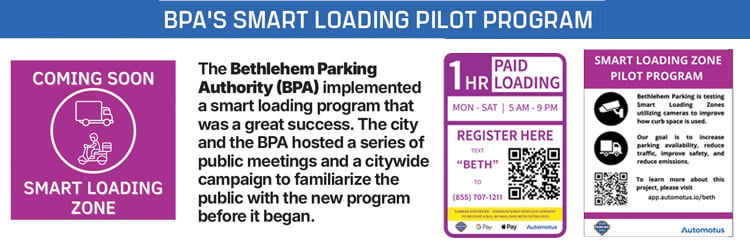
The Bethlehem Parking Authority (BPA), in Bethlehem, Pennsylvania, launched a smart loading zone program in 2023 to modernize curb management and address longstanding issues such as double parking, congestion, and limited space for deliveries. The program introduced a technology-driven system in which commercial vehicle drivers register their vehicles and use a mobile app to enable automated, minute-by-minute payment for curb usage when parked in a designated smart loading zone. This dynamic, pay-as-you-go structure facilitated efficient, equitable use of curb space, discouraging long-term occupancy while prioritizing turnover for active loading and unloading.
To prepare the community for this initiative, the city and the BPA hosted a series of public engagement efforts, including multiple public meetings, a citywide campaign, and door-to-door education. These efforts aimed to inform residents and businesses about upcoming changes and highlight the benefits of transitioning to smart loading zones.
A key aspect of the program’s success was the BPA’s comprehensive review of existing on-street curb usage. As part of this process, the BPA evaluated overall on-street parking utilization and identified several underutilized areas, such as prohibited parking areas or poorly utilized parking spaces. The authority then converted them into free pickup and drop-off spaces with 10- or 15-minute time limits for passengers, e-commerce deliveries, and food pickups, creating a robust foundation for the smart loading zone initiative. Recognizing the complementary nature of commercial and passenger loading zones, the BPA ensured these zones worked cohesively to address the city’s curb management challenges.
Remarkable results
By June 2023, the smart loading zone program was fully implemented, yielding remarkable results. Double-parking incidents decreased by 77%, significantly improving traffic flow and safety.
The program’s success was further enhanced by the new free pickup and drop-off spaces with 10- or 15-minute time limits. Data revealed that the average parking duration within the smart loading zones was just 12 minutes, or less than half the maximum time permitted in traditional loading zones.
The BPA did not charge businesses for obtaining loading zone permits, making the program accessible and widely adopted. This approach not only reduced the prevalence of illegally parked vehicles but also generated additional revenue through the smart loading zones. These funds are being reinvested into street improvements and technology enhancements, ensuring the long-term sustainability and modernization of the city’s parking and mobility infrastructure.
Ensure consistent enforcement
Enforcing parking regulations consistently is essential to discourage misuse of loading zones. By monitoring and penalizing vehicles that exceed permitted loading time or park in these zones without valid reason, cities can ensure efficient curb space utilization and improved traffic flow.
It is common to observe commercial vehicles engaging in illegal parking behaviors, such as double parking, occupying Americans with Disability Act spaces, or blocking fire hydrants, with impunity. Some major delivery companies even allocate budgets specifically for parking citations. Inconsistent enforcement negatively affects traffic flow, public safety, and curb space availability.
The path forward for municipal curb management
The challenge of balancing loading zone needs with parking revenue protection requires innovative solutions and strategic thinking. As demonstrated by the successful program in Bethlehem, cities can achieve remarkable results through smart technology and consistent enforcement.
Efficiently managed loading zones are a cornerstone of modern urban mobility, supporting local businesses, reducing congestion, and enhancing safety. By leveraging advanced technologies like smart loading zones, municipalities can optimize curb space usage while addressing challenges such as illegal parking and double parking. Strategic placement, zone sharing, time restrictions, and collaborative approaches ensure that loading zones remain accessible and practical.
As cities adapt to the growing demands of delivery services and ride-hailing, innovative programs and evidence-based policies will be essential in creating sustainable, efficient urban transportation networks that serve both commercial needs and municipal revenue goals.
NAN CHEN, AICP, MBA, is a parking and mobility consultant for Walker Consultants. She can be reached at [email protected].