

By Larson McDonagh
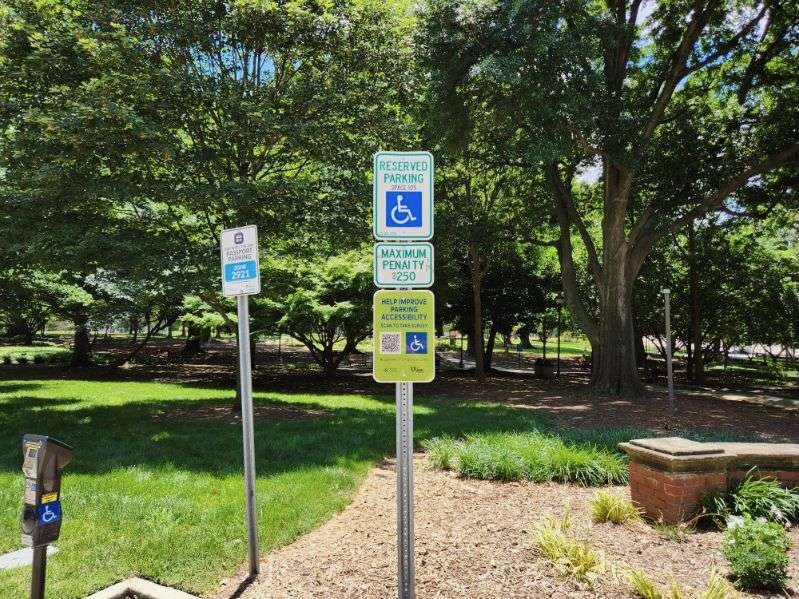
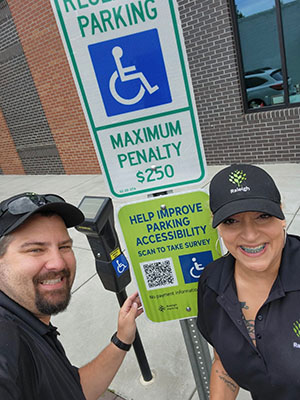
Earlier this year, Raleigh, North Carolina, became the first city to adopt iAccess, a survey tool and phone app designed to help improve on-street parking for people with disabilities. In a move to make Raleigh more accessible, the city installed in mid-June signs hosting QR codes to solicit real-time feedback at 28 metered parking spots that comply with the requirements of the Americans with Disabilities Act (ADA).
Improving access
iAccess enables users to rate, review, and research locations based on accessibility. Businesses and now cities like Raleigh can receive real-time survey feedback about the accessibility of parking, the distance a venue is from parking, bathrooms, and more.
Brandon Winfield, the CEO and co-founder of iAccess, said he and his team are actively working to expand iAccess. The company worked solely with businesses, such as Zoo Atlanta, before implementation in Raleigh.
“Our main goal of the project with iAccess is to better understand the needs of our guests and to help remove barriers when visiting the Zoo,” said Staci Wiech, the vice president of education at Zoo Atlanta. “Instead of guessing at what those challenges are, this tool allows us to receive meaningful feedback from our guests that helps to inform decisions,” Weich said. “Ultimately, our goal is to ensure that Zoo Atlanta is a zoo for all.”
Making connections
Several years ago, the parking technology and mobile payment provider Passport connected with iAccess to collaborate on the development of its app. The collaboration gave customers the option to rate and pay for their parking spots all in one app, Winfield said.
“We expanded iAccess through Passport in 2019 with the purpose of building a mobile application that was kind of like the Yelp of accessibility,” Winfield said. “We always wanted to add different features and bells and whistles that would do more than just allow people to rate and review locations on accessibility.” (When contacted for this story by Parking Today, Passport declined to participate.)
Survey data makes a difference
In 2018, Raleigh’s Parking Leadership Team met with the Raleigh Commission for Persons with Disabilities and the disability advocate organization Triangle, Inc., to obtain critical advice on where accessible metered parking spaces should be located, said Tony Howard, a senior transportation analyst with the City of Raleigh.
Raleigh originally planned to have approximately 15 such spots near medical offices and government buildings. The Raleigh Commission for Persons with Disabilities and Triangle pushed for more metered ADA spaces near restaurants and other social locations, leading to the initial implementation of 20 spaces. Today, the city has 28 accessible metered parking spaces.
“The goal with this iAccess rollout is to help those users point back to us,” Howard said. “Where else are we missing?”
In 90 days, the iAccess survey has received approximately 100 responses, Howard said. Using the current survey data, the city plans to implement two more metered ADA parking spaces in the Fayetteville Street Parking District and another near the Moore Square Parking District.
“We’re excited to be the first [to adopt iAccess] and hope that other cities follow our lead and adopt this as well,” Howard said. “We want to make sure all users of our downtown or any part of our town feel really comfortable, confident, and included when they come visit our city.”
Larson McDonagh is a Western Washington University journalism student interning with Parking Today Media. They can be reached at [email protected].