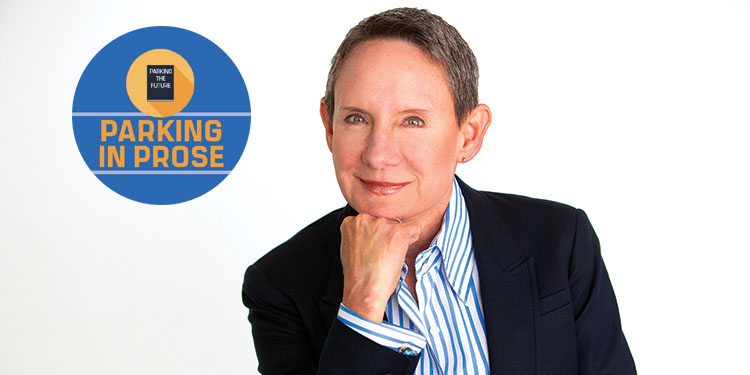




In her memoir, parking veteran Kendra Petty recounts surviving childhood abuse, a cult, mafia threats, and illness while climbing the corporate ladder.
By Jay Landers
Kendra Petty’s life story reads like a thriller novel, except it’s all true. In her 2023 memoir “I Can’t Believe I’m Not Dead,” the longtime parking industry veteran and current executive vice president at Way.com recounts a harrowing journey of survival that includes childhood trauma, a cult led by her own parents, an abusive marriage, attempted murder, and medical battles involving toxic poisoning and breast cancer.
Through it all, Petty built a successful career in the parking industry, climbing the corporate ladder while navigating extraordinary personal challenges. Her book is both an inspirational story of resilience and a jaw-dropping account that proves real life can be stranger — and more terrifying — than fiction. For this installment of our Parking in Prose series, Petty shares insights about trauma, survival, success and sexism in the industry, and what it takes to not just survive, but thrive.

PT: Your book details surviving extreme childhood trauma, including your brother’s death and your parents’ cult. How did those early events shape the person you became as an adult, both the survival skills that served you and the patterns that put you at risk?
Petty: Survival skills are definitely the correct words. I had to constantly adapt to the daily “hair on fire/911” environment growing up. There was constant chaos and rage around me, particularly from my mother and within the cult. So, I learned how to try to fly under the radar to attempt to stay out of the way of the rage. I learned to quickly adapt to my mother’s ever-changing mood and state of mind. I also learned very young to shove my feelings and emotions down to help me survive the toxicity of my home life, the cult, and all the abuse that I went through overall. Surviving such insanity and trauma helped me to be more adaptable in my career. When things were uncomfortable at work, I was good at either flying under the radar, through the storm of a corporate world, or shoving down the negativity that I (and others) might be experiencing and just deal with it. When you have been through childhood abuse and trauma, as I have, your threshold for dealing with toxic situations as an adult is so much higher than if you have not had abuse and trauma in your childhood. I stayed in very, very bad and toxic work and personal situations so much longer than I should have because it was such a pattern for me, and I was so conditioned to the madness. I also had great difficulty recognizing red flags and setting boundaries.
PT: Throughout your story, you’ve had to make the difficult decision to leave, whether it was escaping the cult, leaving an abusive marriage, or ultimately “exploding” the corporate life you’d built. How did you know when it was time to walk away, and what advice would you give to someone struggling with that same decision?
Petty: Learning to walk away or leave has taken literally a lifetime for me. I didn’t leave my extremely abusive home filled with every kind of abuse you could imagine, nor did I leave the cult, until I was 18. I stayed my entire childhood. I finally did get out, moving in the middle of my senior year with my father and then leaving my father’s home right after I graduated high school. I wanted to get as far away as I could, so I moved to New York City to go to university. When you are in an abusive situation — whether it is mental, physical, verbal, sexual, or all the above, as it was for me — you are also mentally manipulated by your abusers into thinking there is no way out and that the abuse is “normal.” Therefore, I unfortunately didn’t leave soon enough. As an adult, I also stayed in several abusive and/or toxic situations and workplaces way too long. Each situation was unique with its own set of circumstances that finally brought me to the point of leaving. But bottom line, in most of those situations I stayed far too long because I was conditioned to live in those terrible and detrimental situations. My advice to anyone in a toxic relationship or workplace is LEAVE. Don’t stay. Don’t wait for the “right time.” The right time is now. Staying will eat away at your mental and physical health, your self-confidence, and your happiness.
PT: You built a successful career as an executive in the parking industry. Can you talk about how this specific industry shaped your professional journey?
Petty: I’ve had an absolutely incredible career and I’m still enjoying it today. I’m deeply grateful for the opportunities I’ve had, but none of them were handed to me. I had to work extremely hard, make sacrifices, and often create those opportunities for myself. Over the years, I moved 13 times for my career, with nearly every move representing a promotion or new challenge.
My work has allowed me to oversee multiple companies, hundreds of markets across multiple countries, and to help build companies into thriving, dynamic organizations. It’s been both rewarding and transformative.
PT: As a woman rising through executive ranks in the parking industry, what forms of sexism did you encounter, and how did you navigate or combat them? Looking back, what strategies worked, and what would you do differently?
Petty: The struggle has been real — and significant. Any woman who’s been in this field for a while knows exactly what I mean. I’ve had to fight for every promotion, constantly proving myself by showing up bigger, faster, and stronger than my male counterparts just to be seen. And, of course, when a woman shows up assertively in a male-dominated company, she’s often labeled in ways that men never are. That double standard has been one of the hardest parts of my professional journey, but also one of the forces that’s driven me to keep breaking barriers.
As a woman advancing through the executive ranks in the parking industry — a space that has traditionally been male-dominated — I encountered several forms of sexism, both subtle and overt. I often found that my ideas or expertise were second-guessed until they were echoed by male colleagues. In meetings, I sometimes had to assert myself more strongly to be heard.
To navigate those moments, I learned to balance professionalism with persistence. I made it a point to speak with authority, back my insights with data, and build strong alliances with mentors and peers — both men and women — who valued competence over stereotypes. Over time, consistent performance and results became the most effective rebuttal to bias.
Another challenge has been the lack of visible female role models at senior levels. I began intentionally mentoring younger women and advocating for inclusive hiring and promotion practices. Creating pathways for others not only helped shift the culture but also reinforced my own sense of purpose in leadership.
Looking back, the strategies that worked best were preparation, self-advocacy, and building networks of support. If I could do anything differently, I’d challenge bias more directly and earlier — especially the subtle kinds that often go unspoken. Silence can sometimes reinforce the very systems we want to change. Today, I encourage women to use their voices confidently, to seek allies, and to remember that leadership is most powerful when it opens doors for others.
PT: Your work eventually put you in the crosshairs of organized crime. Can you share how your corporate role intersected with criminal elements, and what survival tactics you relied on during that terrifying period?
Petty: It took me some time to truly understand how deeply the company I worked for was entangled in criminal activity — and how dangerous that situation really was. I was incredibly naïve at first, especially after spending nearly 15 years as an executive with one of the most ethical and upstanding companies I’ve ever known. The contrast couldn’t have been greater.
At first, I started noticing things that didn’t add up — financial inconsistencies, questionable relationships, and behaviors that raised red flags. When I began asking questions and pushing back, the atmosphere shifted. Eventually, after I became very ill and discovered evidence that I had been deliberately poisoned, I realized the magnitude of what I was dealing with.
Looking back, I can see that I stayed far longer than I should have. I didn’t yet understand how to set firm boundaries or walk away when danger was clear. Part of me wanted answers — to understand why this was happening and to refuse to let them “win.” It may sound irrational, but when you’ve survived trauma before, your instinct sometimes becomes to confront chaos rather than flee from it.
What ultimately got me through that terrifying period were the people who stood by me — colleagues who saw what was happening and quietly helped me navigate through it. Their support, along with my own survival instincts, kept me grounded and alive. I’m still close with several of them today, and I’ll always be grateful for their courage and loyalty.
PT: Between surviving poisoning by toxic compounds and battling breast cancer, you’ve faced extraordinary health challenges on top of everything else. What kept you going during those darkest moments? Where did you find the strength to keep fighting?
Petty: Those were some of the darkest and most painful chapters of my life — both physically and emotionally. Surviving the poisoning and then later battling breast cancer tested me in ways I didn’t know were humanly possible. There were moments when I was so sick and exhausted that I didn’t know how I would keep going. But something deep inside me — that same survival instinct that carried me through my childhood — refused to give up.
What kept me going was a combination of sheer willpower, faith, and the love and support of a few people who truly stood by me. I also drew strength from knowing that I had already survived so much. Every time I thought I couldn’t take another step, I reminded myself: You’ve faced worse. You’ve made it through before. You can do it again.
Another thing that kept me fighting was the desire for truth and justice — to expose what had happened to me, to make sure that the people who did this didn’t destroy anyone else’s life. That’s why I wrote the book and continue to share my story. That sense of purpose gave me energy even when my body and mind felt broken.
In hindsight, those experiences taught me that strength doesn’t always look powerful or fearless. Sometimes strength is just showing up one more day, taking one more breath, and refusing to quit, even when quitting feels easier. I’ve learned that resilience isn’t about never falling; it’s about always finding a way to rise again.
PT: You write about finally realizing you needed to not just survive but thrive, which meant dismantling the life you’d carefully constructed. What does thriving look like for you now, and what’s next for Kendra Petty?
Petty: For so long, my entire focus was on survival — just getting through the next crisis, the next challenge, the next storm. Thriving, for me, meant learning how to live differently. It meant dismantling the life I had built around endurance and finally creating one centered on peace, joy, and authenticity.
Today, thriving looks like freedom — freedom from fear, from toxic environments, from old patterns that kept me small. It’s waking up with gratitude instead of anxiety. It’s allowing myself to rest, to laugh, and to feel safe in my own skin. I’ve learned that thriving isn’t about achieving more or doing more; it’s about being more — more present, more connected, more intentional.
What’s next for me is using my voice and my story to help others who are still in survival mode. I want to continue speaking, sharing my story and my path to healing and mentoring, especially with women who’ve experienced trauma or who are fighting to rise in male-dominated spaces. I believe our stories can be powerful catalysts for change.
Ultimately, thriving means choosing myself — every single day — and helping others see that no matter
how dark things get, healing and transformation are
absolutely possible.
Have you recently written a book about parking? Or know of one that you think others in the industry need to read? If so, contact Parking Today at [email protected] to let us know!
Jay Landers is the editor-in-chief of Parking Today magazine. He can be reached at [email protected].