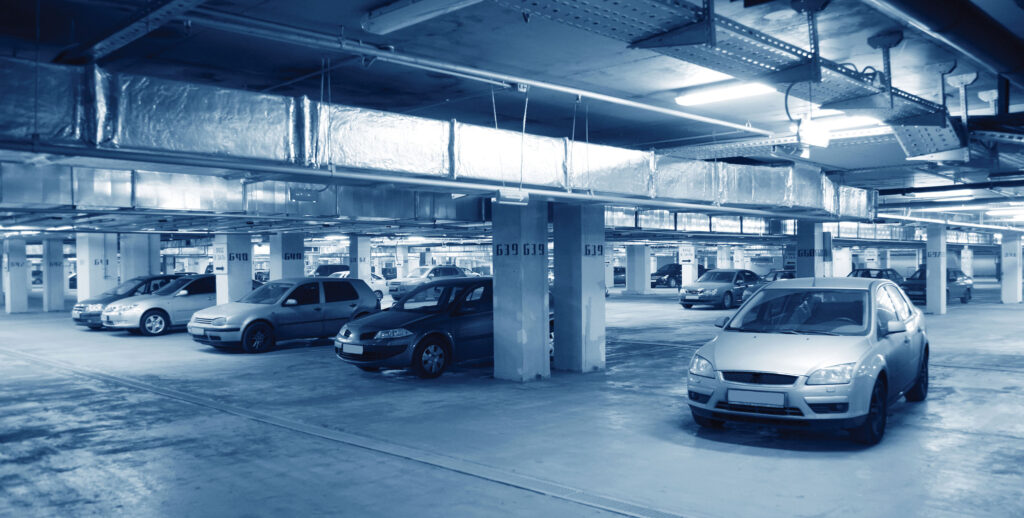

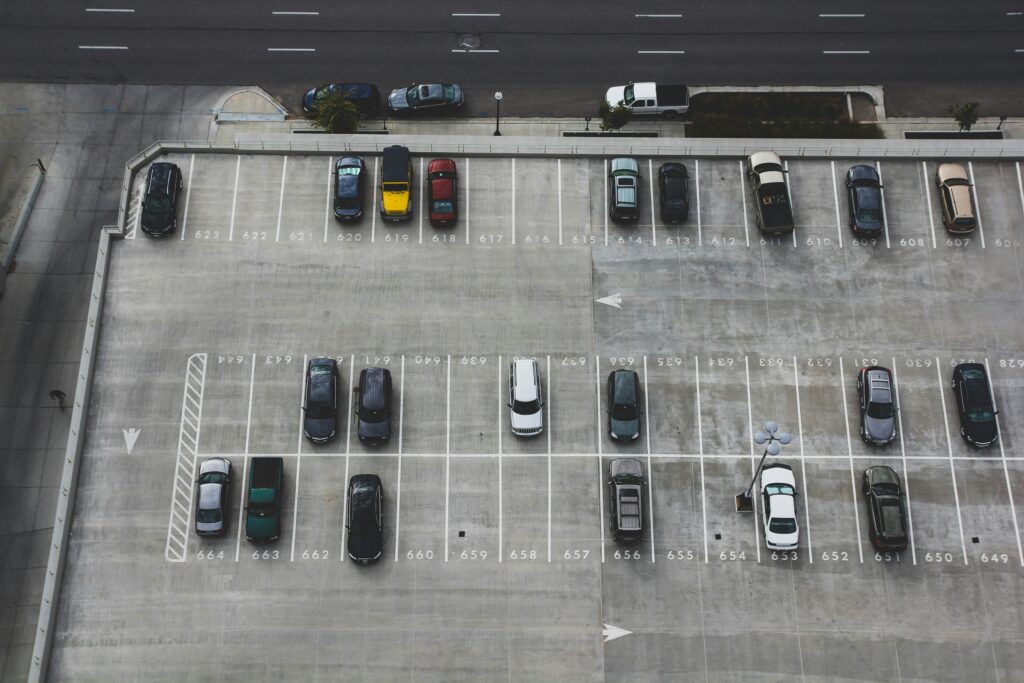


EV adoption, fire safety standards, and AI integration are forcing parking structures to evolve into multifunctional mobility hubs.
PARKONOMICS
A Deep Dive Series on the Economics of Parking
By Frank Ching, CPP
In 2026, the U.S. parking industry is hitting a critical inflection point. No longer a passive utility for vehicle storage, the parking structure is evolving into a sophisticated mobility ecosystem, one that sits at the center of electrification and electric vehicle (EV) adoption, artificial intelligence (AI) integration, and the future of urban design.
As part of a recent national research initiative, I conducted an in-depth analysis of the 2026 infrastructure landscape, culminating in a comprehensive white paper titled “The Evolution of U.S. Parking Structures in 2026.” This research confirms that the traditional “parking garage” is a legacy concept. What has replaced it is a dynamic, high-tech asset that requires a fundamental reevaluation of everything from structural engineering to daily operational management.
The EV weight gap: a structural reckoning
One of the most immediate challenges is the “weight gap” created by the mass adoption of EVs. As of 2026, the data is undeniable: An electric SUV can weigh upwards of 7,000 pounds, representing a 25% to 30% increase in mass over its internal combustion (ICE) counterpart. This weight is not just distributed differently; it is concentrated in the battery pack, creating higher point loads on aging concrete decks.
My research highlights that while historical codes often allowed for a live-load standard of 40 pounds per square foot (psf), 2026 institutional-grade designs have shifted to a 50 psf baseline. Furthermore, barrier impact requirements have jumped to 6,000 pounds to handle the immense torque and mass of these vehicles. For owners of legacy assets, these changes necessitate a shift toward predictive monitoring, using embedded sensors to detect slab stress before it leads to failure.
The safety mandate: NFPA 88A and fire protection
The fire safety profile of the 2026 garage has been unrecognizably altered. Lithium-ion battery fires burn at significantly higher temperatures and involve toxic off-gassing. In my recent white paper, I examine how the NFPA 88A, Standard for Parking Structures, published by the National Fire Protection Association (NFPA), has largely eliminated the “open-air” sprinkler exemption. Automatic sprinklers are now a baseline requirement for new structures.
Building owners must now budget for reclassification to Ordinary Hazard Group 2 (OH2), which requires sprinkler systems to provide more robust fire protection. National data suggests that a basic fire sprinkler system in new construction now costs between $1.50 and $3.00 per square foot, while retrofitting legacy structures can climb to $7.00 per square foot when accounting for the increased water density and mechanical smoke control required to vent toxic gases during a thermal runaway event.
From garage to revenue-generating mobility hub
Perhaps the most optimistic finding in my research is the financial viability of the “Mobility Hub” model. By shifting from a single-use concrete box to a multi-modal hub, assets are seeing significant revenue diversification. Modern “active zones” on ground floors are being converted into last-mile logistics centers and micromobility docks.
The data indicates that these hubs can capture revenue from logistics leases and EV charging margins that were previously non-existent. In fact, underwriting for “tech-forward” assets in 2026 is targeting capitalization rates between 5.5% and 7.0%, as the risk is spread across a broader portfolio of services rather than just transient parking.
AI and the frictionless revolution
Operationally, the “friction” of the gate and ticket has been replaced by AI-driven automation. My analysis confirms that license plate recognition (LPR) is now the dominant national platform. Beyond entry and exit, AI is now used for dynamic pricing models where rates adjust in real-time based on local events and demand surges.
Machine learning algorithms in 2026 can forecast occupancy with nearly 98% accuracy. This facilitates surgical precision in energy use. For example, automated systems dim lighting and reduce ventilation in low-occupancy zones, reducing annual utility expenses by 15% to 20%.
Future-proofing for the smart city
The primary takeaway from my recent research is that the most valuable assets in 2026 are not necessarily those with the most parking spaces, but those with the most flexibility. Building with flat floor plates and 12-to-15-foot clearances may add 10% to 15% to initial construction costs, but it ensures the structure can be converted into housing or office space decades from now.
The parking structure is no longer just about parking. It is the critical connective tissue of the smart city. Those who embrace the “hub” model, prioritizing electrification, AI integration, and structural resilience, will be the ones who define the urban landscape of the next century.
Frank Ching, CPP, is the director of transportation and parking services at the University of California, Santa Barbara. He can be reached at [email protected].