

A journalist and urban researcher explores how America’s relationship with parking reveals deeper truths about cities, economics, and society.
By Jay Landers
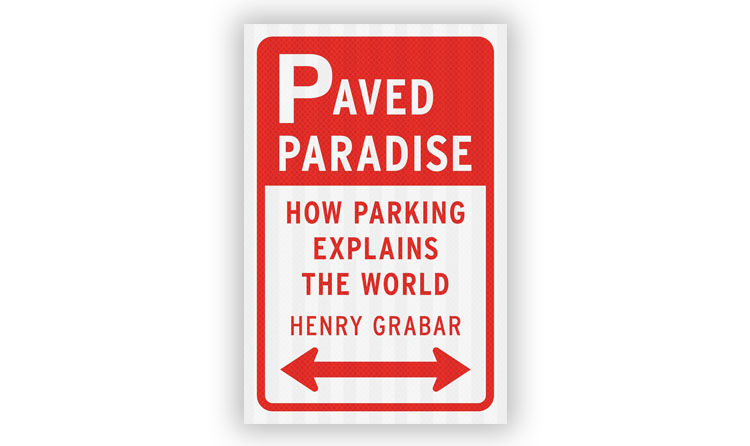
With this article, Parking Today’s “Parking in Prose” series continues with a look at one of the most talked-about parking books in recent years: “Paved Paradise: How Parking Explains the World” by Henry Grabar. Published in 2023, Grabar’s exploration of America’s parking policies garnered significant media attention and achieved remarkable commercial success for a book tackling what many outside the parking industry consider a mundane urban topic. The work demonstrates how parking serves as a lens through which to examine broader questions about cities, economics, and American life.
Grabar brings a journalist’s eye and urban researcher’s perspective to the subject. Since 2016, he has been a staff writer at Slate, where he pens the Metropolis column focusing on housing, transportation, and environmental issues. His work examining cities and urban policy has appeared in prominent publications including the Atlantic, the Guardian, Harper’s, the New York Times, and the Wall Street Journal. In “Paved Paradise,” he applies this expertise to illuminate how parking shapes our communities in ways both obvious and surprising, perhaps even to parking professionals.

PT: What got you interested in parking as a subject worth writing about? How did that come about?
Grabar: I’ve always been interested in the abundance of parking in our cities, simply as what I thought of as a kind of mystery about American land use. Why so much central land was dedicated to storing cars when you compare American cities to their counterparts in Europe or East Asia or Latin America. But then more concretely, my day job is that I’m a reporter and I write a column about cities. I would be researching a story about affordable housing or bus rapid transit or policing and under all these different subjects I would find that parking was a key part of it. I became convinced that this was actually an important part of understanding why cities looked the way they did and that it was a topic worth looking into.
PT: Were there any particular moments or stories that convinced you there was enough there for a whole book?
Grabar: The closest thing I had to a eureka moment was on a trip to Houston after Hurricane Harvey, when I talked to people who were convinced that their houses that didn’t use to flood had started to flood because of parking-forward land use changes that were happening upstream of them. Essentially, the parking-first development pattern was pushing water into their houses in a way that it didn’t before. While those claims are hard to evaluate on an individual basis, the implication was that parking was such a dominant feature of the urban environment in Houston that it had created a kind of manmade floodplain that was actually distinct from whatever was represented on the [Federal Emergency Management Agency] flood maps. And then, in fact, we were operating in a world in which vulnerability to flooding was not caused simply by elevation or proximity to watercourse, but also by this kind of manmade environment that we had created ourselves.
PT: In terms of some of the broader issues you cover, parking minimums is a big one. Since you published your book, there have been more steps toward reducing or even eliminating parking requirements in more cities around the country. Where do you see that movement going? Is it an unstoppable force or is it going to work in some places and not others?
Grabar: I think that the coalition to repeal parking minimums is pretty strong and durable, and that’s because it appeals both to a kind of politically left faction that is interested in creating more affordable housing and more walkable neighborhoods and reducing a kind of legal subsidy to car ownership and use, but also because it appeals to a more traditionally politically right faction that’s concerned with the freedom to do what one wants with one’s land.
PT: In some places where the minimums have either been removed or at least reduced in some ways, the groups financing development projects still want parking to be provided, even when it’s no longer required. Do you think that will change ultimately, or is that just going to remain a thorn in the side of those trying to repeal parking minimums?
Grabar: I don’t think that that is likely to change anytime soon because we have not made very many investments in mass transit in this country. Without substantial investment in mass transit, it’s very hard to convince people that they can live a fulfilling life with fewer than two cars per household. So, obviously builders and businesses continue to provide the parking that they think their clients or tenants need, and that’s just a smart business decision that goes beyond the prescriptions that were given in those books of parking minimums.
PT: You mentioned earlier the insufficient investment in transit in America, and you also talked about the difference between American and European cities. Is it mainly a difference in the transit options that makes the differences between American and European cities so stark?
Grabar: The way I would think of it is as a pattern of development that diverged historically, not because Europeans were any less taken with the automobile. In fact, European car ownership rates are very high — not quite at the level of the United States, but certainly not so low that they explain the difference between the urban environment here and there. Rather, I think that because of the damage inflicted during the Second World War, Europe was just a bit slower to invest in the kinds of giant car-centric infrastructure projects that the United States did. I’m thinking principally of the Interstate Highway System and of urban renewal. Those two things happened in America at a scale that never occurred anywhere else in the world. That’s one reason that the United States wound up with this very singular and automobile-focused urban environment.
European cities like Paris, for example, also had plans to build a bunch of highways through urban neighborhoods. It’s just that they were a little bit behind us in terms of time. By the time that they had gathered the resources to implement those plans, the 1970s had already arrived, along with the oil crisis and the backlash to those kinds of [highway] policies that were rooted both in environmentalism and historic preservation of urban neighborhoods. All of those things began to push back on that highway-and-parking-centric model of development. That happened in Europe before they had a chance to obliterate many of the urban neighborhoods, as happened in the United States.
By the time France, for example, prepares a giant national investment in transportation, the future of the oil-based transportation system is coming into question. So, France invests in nuclear power and high-speed rail instead of investing in the kinds of projects that characterize that kind of big state-led capacity in the United States.
PT: Turning to your book, were you expecting it to do as well as it did?
Grabar: No, I was extremely surprised. I think the only inkling that I had that this subject would strike such a chord with people is that when I said I was writing a book about parking, people always had a very strong opinion about the subject.
Parking is unusual in that it is a completely dominant feature of our environment that, at least, appears to be easy to understand and easy for anyone to form a very strong opinion about. I’m sure your readers are familiar with that phenomenon.
PT: After you released your book and after it started garnering attention, did you hear much about it from people in the parking industry itself?
Grabar: A bit, yes. There is a natural affinity between those people who have caught on to the importance that parking plays in determining the way a city looks and feels and functions and people in the parking industry. And that commonality is rooted in the fact that all of these groups have insight into the fact that parking costs a lot of money to provide.
That is a tier of insight that was not reflected in U.S. policy for many decades. I think one of the core mistakes of [minimum] parking requirements, aside from the fact that they often make inaccurate estimates about how much parking is required and compel everybody to accommodate drivers at every possible site, is that they act like there’s no cost to providing parking. That is one of the reasons that they have had such a profound effect on the way we build things. That’s a tier of insight that people in the parking industry have had since day one: Despite the fact that nobody really wants to pay for parking ever, it is not free to provide parking.
PT: I was wondering if you might care to comment a little about the parking industry today and if there’s anything that you see the industry getting right and then, conversely, if there’s anything that you think it still needs to change or improve.
Grabar: I think there are many cities, as [the late University of California, Los Angeles professor] Don Shoup noted, that would benefit from a more organized parking strategy, one that incorporates paid parking where it’s necessary to organize the congestion at the curb. That’s expertise that the parking industry has.
A private garage can make clear whether there’s room to park and where there’s room to park, which is a big challenge that confronts people who are arriving to a congested main street or downtown arts district, where the perception of limited parking is often at odds with the reality, and people don’t know where the parking is.
PT: When it comes to other aspects of parking policy or practice in the United States, is there a particular thing if you had the power to change it, you would target that?
Grabar: There has been enormous progress on parking and land use to the extent that, in a lot of places, builders and businesses are now free to decide how much parking they want to provide. That permits us to create an urban environment, if that’s what people want and that’s what people want to build. The corollary to that has to be a redesign of our streets in a way that makes it safe and pleasant to get around without a vehicle. That has been much slower coming even in places where lots and lots of people don’t own cars, like my native New York City: You still see tremendous resistance towards redesigning streets with even slower speed limits, planting trees, expanding sidewalks, making it safer to walk, and so on. Unless those changes happen, it’s going to be very hard to convince most people that that’s a trip that’s safe to make without a car.
Have you recently written a book about parking? Or know of one that you think others in the industry need to read? If so, contact Parking Today at [email protected] to let us know!
JAY LANDERS is the editor-in-chief of Parking Today. He can be reached at [email protected].