

Saints follow rules, Gamblers play odds, and Rebels defy restrictions, but technology may shift behavior toward compliance.
By Jerry Green
Editor’s Note: This is the first in a two-part series by the author examining parker behavior and the ways in which compliance and enforcement strategies and different technologies can influence such behavior. To be published in an upcoming issue of Parking Today, the second article will examine a month’s worth of parking data from a U.S. city to answer the question, “If we let drivers pay only for the time they actually park, will we lose revenue?”
When is a parking violation “really” a violation?
On paper, parking rules seem simple enough. Signs are posted, lines are painted, and ordinances are written in plain English. However, ask a dozen drivers what counts as a “real” violation, and you may end up with a dozen different answers, none of which quite match the municipal code.
There’s a common belief among many parkers today that a violation is only a violation when a ticket materializes on the windshield. Until then, everything exists in a kind of philosophical gray zone. It’s the curbside version of the old riddle: “If a tree falls in the forest and no one is there to hear it, does it make a sound?” For many drivers, it becomes: “If no ticket is written, was the violation really committed?”
One day, while assisting officers on the street with a new enforcement rollout, I was approached by a resident with a puzzled expression. “Why did I get a ticket for parking in front of my own house?” she asked. When I explained that parking on her side of the street was by permit only, she blinked in disbelief. “Well, I’ve been parking there for over a year and never got a ticket,” she replied.
In her mind, the consistency of past non-enforcement had become the actual rule; the signage was merely decorative.
That moment illuminated something we see every day in curbside management: Drivers often don’t follow the written rules; they follow the rules they believe are enforced. Over time, that creates its own ecosystem of parking personalities.
Saints, Parking Gamblers, and Curbside Rebels
Parking behavior, much like traffic itself, tends to fall within three distinct types: the Saint, the Parking Gambler, and the Curbside Rebel. You may recognize them.
The Saint is the driver who restores your faith in urban order. They read signs. They pay the meter. They leave before their time expires, even if no enforcement officer has been spotted within a half-mile radius. These are the people who stop before the crosswalk line, not on it. Saints don’t block ramps “for just a second,” or squeeze into loading zones while muttering, “Nobody will notice.”
Their inner monologue while parking is a model of civility. If everyone parked like them, parking enforcement would be a serene, almost spiritual occupation.
Then we have the individual who treats parking like a spirited round of blackjack. The Parking Gambler loves playing the odds. They’ll roll slowly past a No Parking sign, tilt their head at a 45-degree angle, squint, and interpret the wording like a legal scholar searching for loopholes. “No parking between 8 a.m. and 10 a.m.” But it’s 9:47. And they’ll “only be five minutes.” What harm could there be?
This is the driver who sits in the car with the engine running and asks, “Does this really count as Standing in a No Parking or Standing Zone?” They’re half convinced that as long as the motor is on or they are in the vehicle, they’ve discovered a loophole in physics that exempts them from the municipal code.
If a Parking Gambler approaches a busy curb, you can almost see the roulette wheel spinning behind their eyes: Will I get a ticket? Will the meter tech walk past? Has enforcement already swept this block? What’s the probability? Every space becomes a wager. Every sign becomes a suggestion. Every enforcement cycle becomes a game clock.
And then there is the Curbside Rebel, the driver who takes parking defiance to operatic levels.
This is the one who will pull into a loading zone, a handicap space, or the exact spot the tow truck just cleared and do it with a kind of confident innocence that suggests everyone else is overreacting. They don’t just play the odds; they push them, test them, and redefine them.
Ask them why they parked in a Handicap Parking Only zone and you’ll hear something like, “I was only going to be five minutes,” which in curbside time translates to anywhere between five and 35 minutes, depending on how long the line was inside the coffee shop.
Some will sit patiently, hazard lights blinking like emergency permission beacons, waiting for a towed vehicle to depart so they can glide into the freshly liberated illegal space. You couldn’t script this stuff.
Will technology ever turn Curbside Rebels into Parking Saints?
Let’s be honest: We’ll never reach a world where every parker behaves perfectly. The curbside ecosystem thrives on diversity, after all. But technology can influence behavior and perhaps even soften some of the sharper Curbside Rebel edges.
Historically, enforcement was the only real lever cities had. But today we stand at a moment where two forces, technology-driven enforcement and frictionless compliance, can work together to reshape the entire psychology of parking.
The hammer: technology that makes enforcement consistent
In the past, drivers behaved based on what they thought was being enforced, not what was written. That ambiguity fed the instincts of the Parking Gamblers and Curbside Rebels.
Modern tools are changing that. Cameras, automated systems, data-driven patrols, and clearer records reduce the perception of randomness. Once enforcement becomes more predictable, the “game” becomes less fun, and even the Gambler begins leaning toward better behavior.
The Curbside Rebel? They won’t disappear, but their opportunities to perform curbside antics shrink dramatically.
The carrot: technology that makes parking effortless
But the real magic happens when compliance becomes simple.
Emerging technologies, especially those connected to vehicles and networks, are beginning to transform the relationship among drivers, streets, and information. Systems are evolving that enable vehicles and smartphones to understand:
• Where a vehicle is parked
• What are the rules for that specific space
• When should payments begin or end
• How long the driver has been parked
• What rate is in effect at that moment
Imagine a system where parking feels as seamless as driving through an automated toll lane, where drivers no longer need to interpret confusing signs, open apps, or guess how long they’ll stay. This removes the emotional friction that fuels Gambler behavior and the frustration that triggers Curbside Rebel impulses.
If finding, understanding, and paying for parking becomes almost effortless, suddenly the Saint-like choice becomes the natural response.
‘Talking’ vehicles are shaping parking’s future
In the October 2025 issue of Parking Today, Katherine Beaty highlighted in her article titled “V2X: Your Car Is Talking. Is Parking Listening?” the importance of emerging vehicle-to-everything (V2X) communication. Today, that prediction is already unfolding. Vehicles are beginning to “talk” to the digital world around them, sensing hazards, reading signals, and understanding the environment in ways that were impossible even a decade ago.
As this matures, parking will transform.
Picture this: A car enters any city block and instantly knows the parking rules, the rates, and the spacing. The driver gets nudged when their time is nearly up, or the vehicle stops the session automatically when it pulls away. No sign interpretation. No risky wagers. No “just five minutes.” No philosophical debates about whether sitting in the seat counts as being parked.
With seamless cues and automatic convenience, even the Gambler loses the thrill of the gamble.
Vehicle makers have already started to incorporate this technology into some current and future models. For example, the automakers BMW and Mercedes Benz have begun adding this technology into their vehicles (see table).
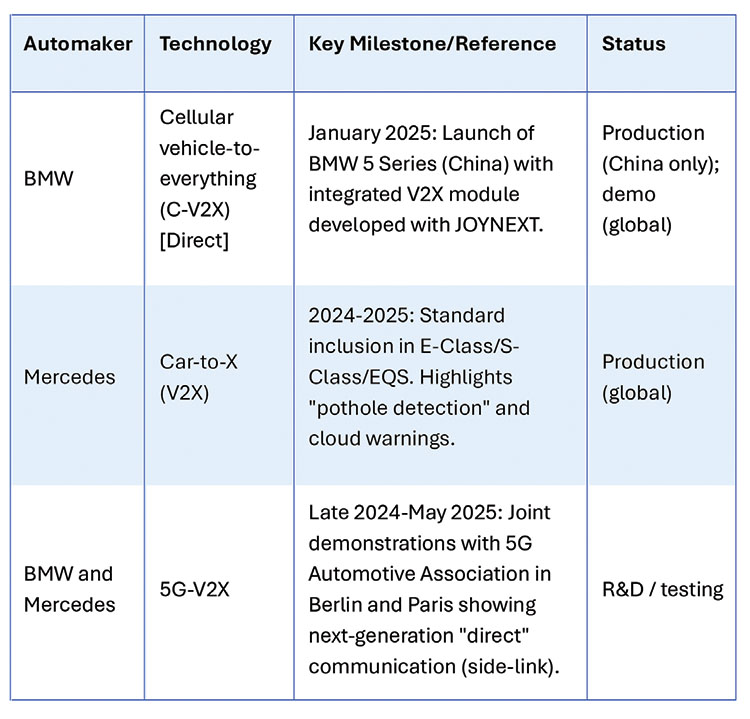
Soon, application development companies will start to develop products and applications that may first leverage cellular vehicle-to-network (C-V2N) technologies, and then cellular vehicle-to-everything (C-V2X) and V2X technologies to the broader community. Some of the advances this could bring are:
• Collision avoidance.Vehicles communicate directly with each other to anticipate potential hazards and take preemptive action, such as slowing down or changing lanes.
• Intersection movement assist. Vehicles are alerted to potential collisions at intersections, improving safety during cross-traffic situations.
• Traffic signal control. C-V2N technology optimizes traffic signal timing based on real-time traffic conditions, enhancing traffic flow and reducing congestion.
•Route guidance. Vehicles receive the most efficient routes based on current traffic conditions, improving navigation and travel time.
• Platooning. C-V2N technology enables vehicles to follow each other closely, optimizing traffic flow and reducing congestion.
These applications demonstrate the transformative potential of these technologies in creating safer, more efficient roadways and advancing the adoption of autonomous vehicles.
When we make it easier to comply with sensible parking standards and rules, we encourage compliance because parkers are less likely to think about it. The world likely will be a better place with more Parking Saints. At the very least, it will make our
jobs easier.
Will we ever have a city full of Parking Saints?
Not really, and that’s OK.
Human behavior is rich, flawed, unpredictable, and occasionally hilarious. But with smarter tools on both the enforcement and compliance sides, we can shift the balance. We can reduce frustration, minimize chaos, and help more drivers behave, not because they fear the hammer, but because the carrot makes the right choice the easy thing.
Technology may not change human nature, but it can absolutely change parking behavior.
And if it can turn even a few Curbside Rebels into near saints, well, that’s a miracle any city would welcome.
JERRY GREEN is the president and chief information officer of Caryl Technologies LLC. He can be reached at [email protected].