

A recent survey shows customers prioritize reliability and control over convenience, resisting forced digital parking systems due to trust concerns and app fatigue.
By Art Alabin
Last year during our search for a new car, my wife and I test-drove several vehicles, including a Mercedes-Benz AMG GLE. The experience was surprising. Mercedes claimed research supposedly had shown that luxury performance buyers wanted amplified engine sound to compensate for the quietness of modern electric vehicles.
Try as I might, I could not find any source material for this research, beyond an uncited reference to it on LinkedIn. However, Mercedes gave so much credence to it that they piped engine noise through speakers into the cabin. Unfortunately, the sound could not entirely be turned off. Even at its lowest setting, it sounded like we were standing beside an idling motorcycle. After several test drives in disbelief, we purchased another brand instead.

This experience illustrates what happens when companies misunderstand customer needs. A luxury vehicle should provide the luxury option of complete quiet. Whether the absence of this option resulted from flawed or inadequate research, the result was the same: poor customer experience.
The parking industry faces similar challenges. New technology is frequently introduced without fully understanding how customers will react. In some cases, both operators and consumers suffer. Looking to gain insight into public attitudes toward parking payment and enforcement systems, my mystery shopping company, Servimer, recently surveyed more than 2,100 drivers. We found that drivers want flexibility, transparency, and reassurance more than speed or innovation. Although customers appreciate digital convenience, they do not want to be forced into systems that feel unreliable, intrusive, or untrustworthy.
The 2026 parking customer experience study
As a mystery shopping provider, Servimer has access to the perspectives of thousands of independent contractors, providing an opportunity for research free from any profit-driven influence or confirmation bias.
In early 2026, we surveyed our contractors to learn how they view the following types of parking payment and enforcement systems: automatic payment, phone app, text message with payment link, machines that accept cash or credit cards, and human attendants. The survey received responses from more than 2,100 drivers across the United States and Canada between the ages of 18 and 80. The survey also generated more than 600 written comments, revealing strong emotional reactions and clear behavioral patterns.
Among the respondents, 75% were male and 25% were female. In terms of age, 39% were Generation X (ages 46-61), 30% were Millennials (ages 33-45), 28.2% were Baby Boomers (ages 62-82), and 2.8% were Generation Z (ages 17-32).
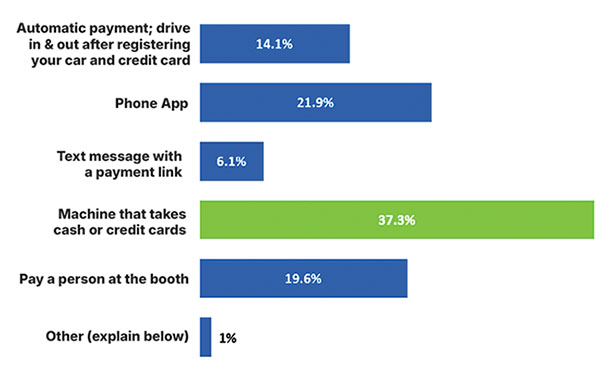
The first question asked participants which of the five payment options they would prefer to use, if all were available at a parking facility. As shown in Table 1, approximately 37% indicated they would choose to use a machine that accepts cash or credit card, nearly double the percentage of respondents who would prefer to use a phone app (21.9%). Approximately one-fifth of respondents, or 19.6%, would prefer to pay a human attendant, followed by automatic payment (14.1%) and payment by text message (6.1%).
Table 1: If you parked at a garage where all of these options for payment were available, which one would you choose to use?
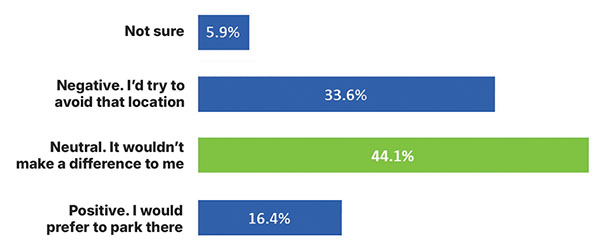
The second question asked participants how they would feel about parking at a facility that only accepted payment via phone. As shown in Table 2, more than three-quarters of respondents indicated that they would feel neutral (44.1%) or negative (33.6%). Slightly more than 16% said they would prefer to park in such a facility, while nearly 6% indicated that they were not sure.
Table 2: If a parking location’s only means of paying was by phone, how would that affect your decision
to park there?
The survey then asked respondents to rate their level of satisfaction based on their experience with three common digital payment systems: autopay, meaning drive in and out after registering a vehicle and credit card; pay by phone app; and pay by text.
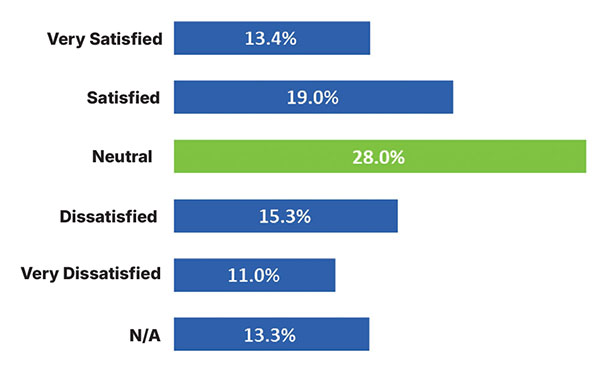
As shown in Table 3, 28% said they felt “neutral” about the autopay approach, while 19% reported being “satisfied” and 13.4% said they were “very satisfied.” By contrast, 15.3% said they were “dissatisfied” and 11% reported being
“very dissatisfied.”
Table 3: How satisfied are you with autopay?
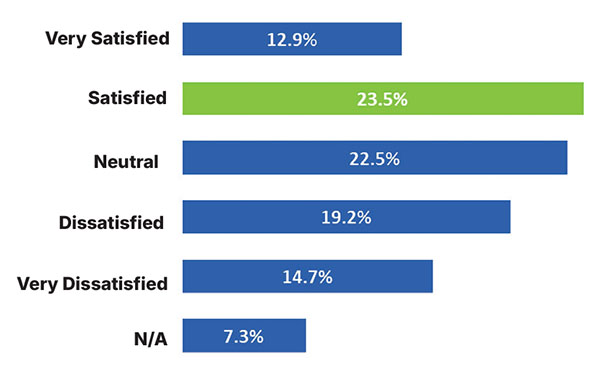
When asked to rate their level of satisfaction with the process of installing and using a free phone app to pay for parking by credit card or digital wallet, 23.5% of respondents said they were “satisfied,” a single percentage point higher than “neutral” (22.5%) and more than 10 percentage points above “very satisfied” (12.9%), as shown in Table 4. Nearly one in five respondents (19.2%) reported being “dissatisfied,” while 14.7% said they were “very dissatisfied.”
Table 4: How satisfied are you with paying by phone app?
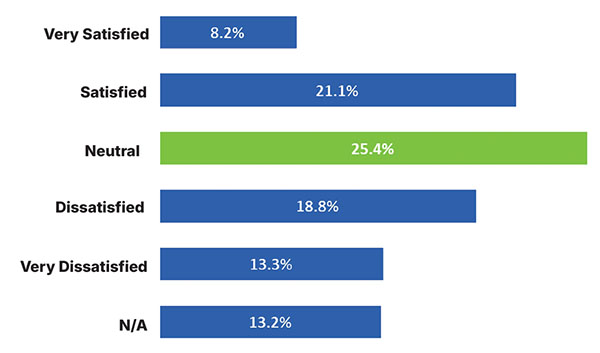
When asked to rate their level of satisfaction with the process of texting to receive a link to be used to pay by credit card or digital wallet, approximately one-quarter (25.4%) of respondents said they were “neutral,” while 21.1% indicated they were “satisfied” and 8.25% said they were “very satisfied” (see Table 5). Nearly one in five (18.8%) said they were “dissatisfied” and 13.3% said they were “very dissatisfied.”
Table 5: How satisfied are you with paying by text?
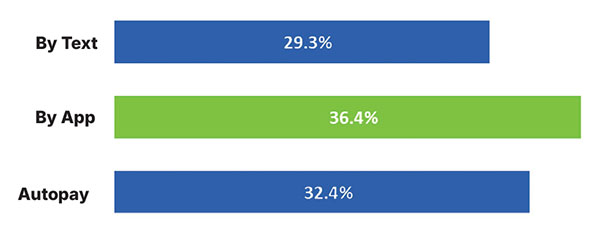
Combining the percentages of respondents who indicated they were “very satisfied” and “satisfied” for each of the three digital payment options enables a comparison of consumer attitudes toward the different methods. As shown in Table 6, survey participants had the highest level of satisfaction for payment by app (36.4%), followed by autopay (32.4%) and payment by text (29.3%).
Table 6: Comparing satisfaction levels among the digital payment options
Finally, survey participants were asked to state how they would respond to the following scenario: “You parked at a location where you paid by phone and followed instructions to pay. Later, you received a collection notice in the mail with a large service fee. Your credit card account shows no payment was made. How would this make you feel?”
As shown in Table 7, nearly one-quarter (24.2%) of respondents said they would be “confused” because they thought that they had paid, 23.9% would feel “frustrated” because of the added service fee, nearly the same number (23.7%) would feel “angry” because the “instructions for payment must not have been clear enough,” 19.9% would feel “annoyed” for receiving the notice long after the parking session, and 4% would feel “embarrassed” for failing to pay.
Table 7: How would you respond to receiving a collection notice in the mail with a large service fee after you thought you had paid for parking by phone?
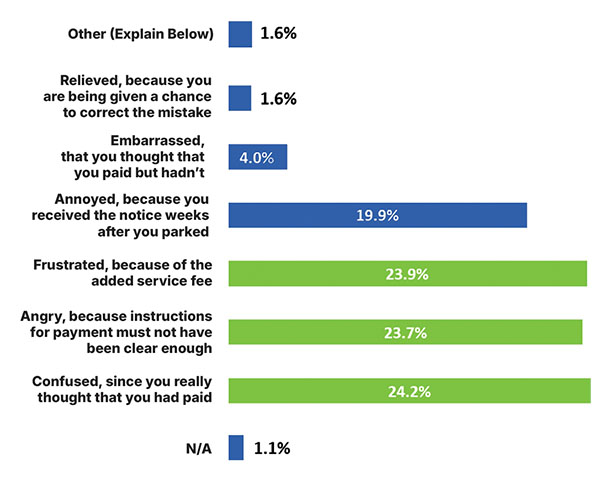
This question generated the most comments and was the strongest emotional driver for both genders. Male responses more often indicated anger, expressing frustration with system mechanics. Female responses more often indicated confusion, emphasizing uncertainty (“I thought I paid”).
Customer psychology and digital resistance
Written comments from survey participants offered key insights regarding what they like and don’t like about digital payment options:
• Optionality. Drivers value choice.
• Low commitment. Drivers dislike downloading apps or creating accounts for occasional parking visits.
• Control. Drivers resist systems that remove their ability to choose how they pay.
Resistance to apps appeared in the comments as a very strong signal. However, this signal is not friction but rather is a psychological resistance to privacy concerns or app fatigue, as revealed by the following comments:
• “don’t want to download an app”
• “may not use again”
• “sick of apps”
• “everyone wants to get into our phone”
Many drivers also shared reliability concerns with digital systems in general, noting worries about dead phone batteries, frozen apps, poor cellular service, QR code safety, or unclear payment confirmations.
On the other hand, some survey respondents highlighted the convenience associated with digital payment approaches, noting that they are seamless, convenient, and don’t require onboarding or interaction after setup.
Parking technology does not exist in isolation. Customer perception is influenced by the entire environment, and these perceptions often differ between men and women. In fact, the study revealed consistent differences between male and female respondents. Male drivers of all ages tend to prefer efficiency and automation, while female drivers, also of all ages, tend to prefer assurance and human interaction.
This distinction matters because women influence most household purchasing decisions and often place greater emphasis on personal safety, cleanliness, lighting, and clarity of signage. A parking facility with poor lighting, overflowing trash, or confusing signs creates resistance toward any new digital system introduced within it. Visual design also matters. Better and diverse colors, clearer signage, and more welcoming environments improve customer comfort and acceptance. Parking operators who ignore these factors risk slowing customer adoption of new technology.
Recommendations for the parking industry
The research suggests several important actions to be taken by parking operators and technology providers:
• Avoid digital-only systems. A hybrid model remains essential, including pay stations, optional apps, and human assistance when possible.
• Prioritize trust over innovation. Reliability, transparency, and confirmation are valued more than speed or innovation.
• Improve enforcement practices. This is the biggest reputational risk, requiring improved clarity of rules, instant confirmations, and elimination of perceived “gotcha” penalties.
• Reduce digital friction. If apps are used, they should require minimal setup, no forced downloads, simple user interfaces, and clear receipts and confirmations
Convenience for parking patrons means predictability and simplicity.
Like the Mercedes that lost a sale by forcing unwanted engine noise, parking operators who force digital-only systems misunderstand what customers value: not innovation, but choice, control, and the trust earned through flexibility.
ART ALABIN is the CEO of Servimer. He can be reached at [email protected].