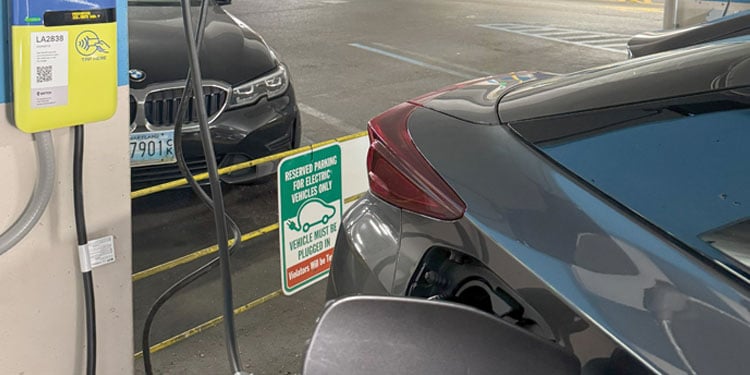





As EV adoption accelerates, forward-thinking parking facility operators are discovering that charging infrastructure delivers far more than fee-per-session revenue: It’s reshaping their business models entirely.
By Samuel Bordenave
The conventional wisdom surrounding electric vehicle (EV) charging infrastructure has been straightforward: install chargers, collect charging fees, and achieve payback within several years. Although this approach works, it undervalues the broader economic opportunity emerging from the rapid transformation of the transportation sector. Ignoring this broader potential means leaving significant revenue on the table and risking future competitive disadvantage.
Consider the findings published in 2024 by researchers from the Massachusetts Institute of Technology and other institutions analyzing more than 4,000 charging stations and 140,000 businesses in California. The study found that charging infrastructure boosted nearby retail spending by up to 3.2%.
The implication is clear: EV drivers demonstrate unique behavior in comparison with drivers of internal-combustion-engine vehicles. It demonstrates the need for a fundamental shift in how parking operators view EV charging infrastructure.
For leaders in EV charging deployment, chargers function as a business transformation tool, one that attracts premium customer segments, enables long-term contract revenue, and creates powerful cross-industry partnerships that extend well beyond traditional parking economics.
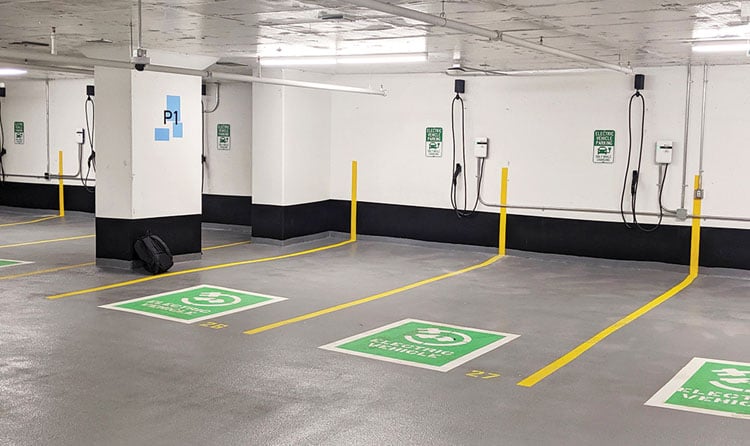
Driving more parking business with EV charging
The current supply-demand imbalance in EV charging infrastructure presents an immediate competitive opportunity. In a 2023 report, the National Renewable Energy Laboratory within the U.S. Department of Energy projected a need for more than 1.2 million public charging ports by 2030, a massive expansion from current infrastructure levels. This scarcity positions early-adopting facility operators to capture market share in a rapidly expanding sector.
More importantly, the customer base driving this demand represents a particularly valuable demographic. Urban apartment dwellers, condominium residents, and homeowners with inadequate electrical systems comprise millions of EV drivers who depend entirely on public charging infrastructure. These segments are not merely looking for a parking spot; they are actively seeking reliable, convenient, and predictable charging solutions crucial to their daily lives. By providing this essential service, parking facilities don’t just fill a space — they foster deep customer loyalty, turning transient visitors into consistent, high-value patrons.
Savvy operators are moving beyond simply installing chargers and hoping for the best. They’re developing comprehensive digital visibility strategies, ensuring their facilities appear prominently in searches within PlugShare, Google Maps, and Apple Maps. They’re partnering with roaming-enabled charging networks to maximize accessibility across payment platforms. Most critically, they’re measuring success not just by charging session revenue, but by the broader economic effect on their overall business.
Higher fill rates and increased brand awareness and preference are significant advantages, particularly in habit-driven sectors like parking. By installing charging stations today, a facility can lock in customers for years to come.
Connecting with fleets for additional, secure revenue
Perhaps the most significant near-term opportunity lies in corporate fleet electrification. Research released in June 2024 by the automotive services and technology provider Cox Automotive indicates that 87% of fleet managers expect to add EVs within the next five years. However, charging infrastructure availability remains a top operational concern. To them, access to convenient, reliable charging infrastructure is critical to maintaining their operational schedules, minimizing downtime, and optimizing their total cost of ownership. This crucial need is often difficult to fulfill in-house, creating a substantial business development opportunity that parking operators are beginning to capitalize on through fleet partnership agreements.
Fleet partnerships deliver something traditional parking revenue cannot: contracted income streams that provide immunity from daily demand fluctuations. Regional courier companies, meal delivery providers, and e-commerce logistics operators are actively seeking reliable charging partners. Corporate campuses need overflow charging capacity for employee vehicles. Government agencies require distributed charging solutions for their electric fleets.
The key is developing a pricing strategy that offers discounted parking and charging for longer agreements, incentivizing multi-year contracts while providing fleet operators with the reliability they require. These partnerships typically involve contracts ranging from several months to as long as five years, creating predictable cash flow that improves the economics of parking facility operations.
From amenity to anchor
The strategic principles outlined above are well illustrated by Harbor Park Garage in Baltimore, which successfully deployed and upgraded charging infrastructure during the course of about a decade across multiple revenue streams.
While nearby competitors installed chargers without promotion or care, Harbor Park used charging as a customer acquisition tool, systematically expanding from 2 to 20 chargers as demand grew. Harbor Park established itself as the reliable solution for local EV drivers while competitors abandoned the market entirely. Not only did this provide revenue from charging, it also led to increased occupancy of Harbor Park’s facility.
The strategic value became clear when a local company’s 50-vehicle fleet required parking. The deciding factor? Harbor Park’s ability to guarantee charging for the fleet’s single EV. It’s a clear demonstration of how EV infrastructure can capture large-scale business relationships that extend far beyond the charging revenue itself, even when the actual need for charging is relatively modest today. By having a flexible EV charging solution, Harbor Park was able to secure a five-year contract for its new customer’s entire fleet.
It’s an advantage that is likely to persist thanks to Harbor Park’s market leadership. It now operates 20 chargers, while competitors who initially attempted EV charging ultimately removed their equipment due to poor execution and promotion.
Building for success in an electric mobility future
Adoption of EV charging infrastructure represents more than a revenue enhancement opportunity: It’s a savvy business decision that will influence competitive dynamics for decades. As EV adoption accelerates, facilities that establish charging infrastructure early will possess significant advantages in customer acquisition and retention.
The transformation is already underway. The operators who recognize this shift and implement comprehensive revenue strategies now will establish market leadership positions that become increasingly difficult for competitors to challenge as the industry matures. The window for first-mover advantage remains open, but it will narrow rapidly as awareness of these opportunities spreads throughout the industry.
For parking facility operators ready to seize the opportunities afforded by EV charging, success depends on rethinking the nature of charging infrastructure. By thinking of it as a comprehensive business model transformation rather than a simple amenity addition, it’s possible to unlock multiple revenue streams and new, sustainable competitive advantages. The facilities that master this approach first will be among those best-positioned to thrive in the near future when EVs are not just more common, but the default choice for most drivers.
SAMUEL BORDENAVE is the chief commercial officer at SWTCH. He can be reached at [email protected].