

When drivers pay only for time actually used, compliance increases, loopholes disappear, and cities generate sustainable revenue through trust rather than resentment.
By Jerry Green
Editor’s Note: This is the second in a two-part series by the author examining parker behavior and the ways in which compliance and enforcement strategies and different technologies can influence such behavior. Part one, titled “The Three Faces of Parking Behavior,” appeared in the June 2026 issue of Parking Today.
On any weekday morning, the curb tells a story long before the data ever does.
A resident pulls into a business district space to grab a prescription. They expect to be inside for 10 minutes. The meter asks them to choose a duration: 15 minutes, 30 minutes, an hour. Unsure, and unwilling to risk a ticket, they choose 30 minutes.
Inside, the line moves slowly. By the time they return, 45 minutes have passed. That driver didn’t plan to break the rules. But at that moment, they crossed an invisible line, from Parking Saint to Parking Gambler.
This small, routine decision is where most parking non-compliance begins. Not with defiance, but with guesswork.
My previous article, “The Three Faces of Parking Behavior,” introduced three parking personalities familiar to anyone who manages the curb:
• The Parking Saint, who reads signs, pays correctly, and leaves on time, even when no enforcement officer is in sight
• The Parking Gambler, who usually means well but plays the odds
• The Curbside Rebel, who treats parking rules as suggestions rather than requirements. In this follow-up, we move beyond personality and into proof
The earlier article highlighted how advancements in such technologies as cameras, automated systems, data-driven patrols, and connected vehicles are likely to nudge Parking Gamblers and Curbside Rebels to act more like Parking Saints. However, these same advancements make it easier for parkers to pay only for the time they need, raising the question that many parking authorities quietly wrestle with: If we let drivers pay only for the time they actually park, will we lose revenue?
Using real parking transaction data from April 2025 in a mid-sized eastern U.S. city (referred to here as the Sample City), we looked to answer this question. As it turns out, the data suggests the opposite. This should not come as a surprise. Transportation researchers have long observed that drivers respond differently to parking rules, enforcement visibility, and risk, a reality anyone working the curb recognizes immediately.
The system drivers respond to
The Sample City’s parking rules will sound familiar to most readers.
Metered parking operates seven days a week from 9:00 a.m. to 9:00 p.m. Business district spaces cost $0.75 per 15 minutes ($3 per hour), while other zones cost $0.50 per 15 minutes ($2 per hour). Payments are collected via pay-by-plate meters and a mobile app.
Residents with valid on-street permits receive an automatic 50% discount when paying through the app. Non-residents are limited to four hours in paid zones. Residents may exceed that limit in permit zones.
On paper, it’s a reasonable system. At the curb, it behaves very differently.
Guesswork as policy
The system asks every driver the same question: How long will you be here?
For many trips, shopping, dining, medical appointments, that question has no reliable answer. Drivers adapt the only way they can. Some overpay “just in case,” quietly resenting the system. Others underpay and hope enforcement doesn’t notice.
Over time, this guess-and-overpay model trains behavior. Parking Gamblers aren’t born; they’re created.
When we examined the Sample City’s April 2025 data, this pattern appeared immediately.
The Sample City provided two datasets: short sessions (fewer than 120 minutes) and long sessions (120 minutes or more). Together, they represented 151,083 parking sessions and $692,048 in revenue for the month.
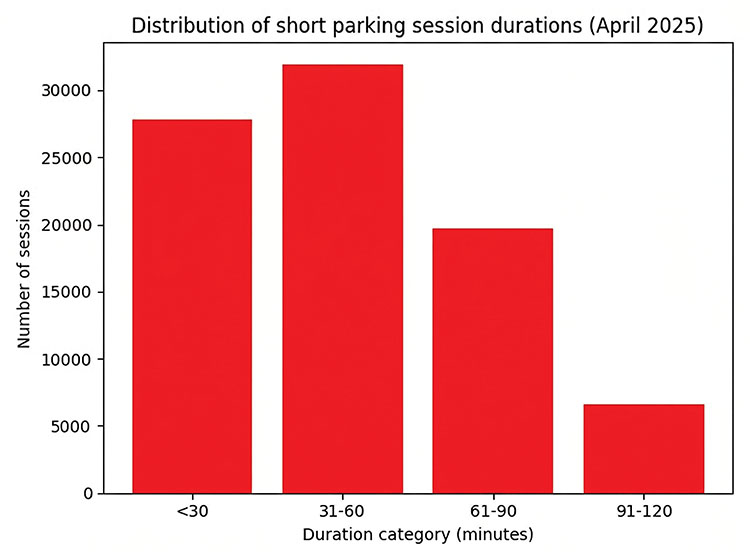
The first surprise was how brief most parking sessions actually are, with most lasting less than an hour (see Figure 1).
FIGURE 1. Distribution of the Sample City’s short parking session durations (April 2025).
The most common long sessions are two to two-and-a-half hours and three-and-a-half to four hours (see Figure 2).
FIGURE 2: Distribution of the Sample City’s long parking session durations (April 2025).
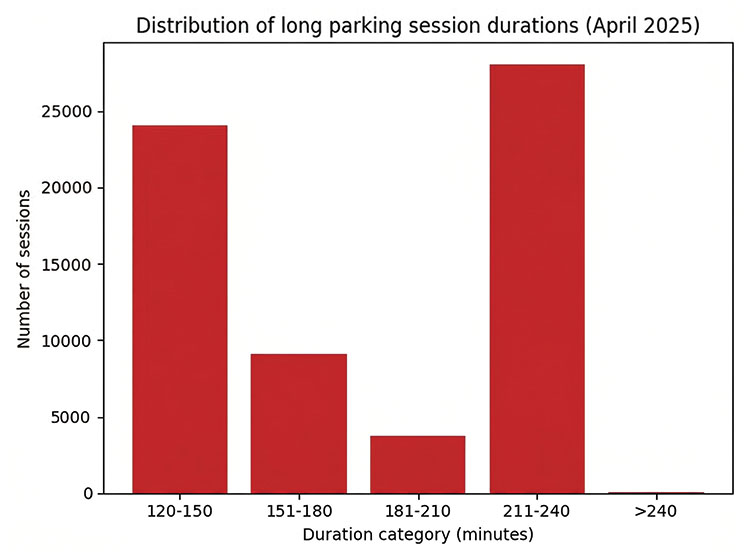
More than half of all sessions lasted less than two hours. Short sessions averaged 53 minutes. Across all sessions, short and long combined, the average stay was just 110 minutes, or less than two hours.
In other words, the curb is mostly used by people who don’t need much time. Yet the system nudges them toward buying more than they use.
The four-hour pattern that wasn’t an accident
At the other end of the spectrum, the long-duration data told a different story. Long sessions averaged 186 minutes, but they didn’t spread evenly. They clustered tightly, almost unnaturally, around the four-hour maximum.
More than 25,000 sessions lasted exactly 240 minutes. Another 799 sessions fell between 235 and 239 minutes. In total, about 40% of all long sessions landed right at the ceiling. That level of precision doesn’t come from coincidence. It comes from behavior shaped by policy.
How a time limit became a loophole
The four-hour limit was designed to promote turnover. In practice, it taught drivers how to stay put. Because mobile payments rely on manually entered zone numbers, and enforcement officers lack real-time location verification, drivers discovered they could simply purchase another four-hour session in a neighboring parking zone, without moving their vehicle.
The data confirmed it:
• 4,083 plate-day combinations showed the same vehicle purchasing multiple four-hour sessions on the same day.
• Some vehicles effectively parked from 9:00 a.m. to 9:00 p.m. in one space.
This wasn’t rebellion. It was rational adaptation. The system didn’t enforce the rule; it taught drivers how to bypass it.
Who pays the price
When long-term parkers occupy prime curb spaces all day, the effect ripples outward. Visitors circle the block. Shoppers give up. Restaurants lose quick-turn customers. High-turnover revenue opportunities disappear.
Meanwhile, enforcement officers are placed in an impossible position. They can see time paid, but often not whether it was paid correctly. Without verified location data, enforcement becomes manual, inconsistent, and frustrating, for officers and
drivers alike.
The system ends up rewarding those who know how to game it, while penalizing the Parking Saints who follow the rules.
Revenue tells a different story than fear
One of the most persistent fears in parking is that fairer pricing will reduce revenue. However, the April 2025 data tells a more nuanced, and more encouraging, story. Total monthly revenue was $692,048, with an average of $4.58 per session. Long sessions generated about 72% of total revenue, with the 211-to-240-minute category generating the most revenue (see Figure 3).
FIGURE 3: Revenue by duration category and source for long sessions.
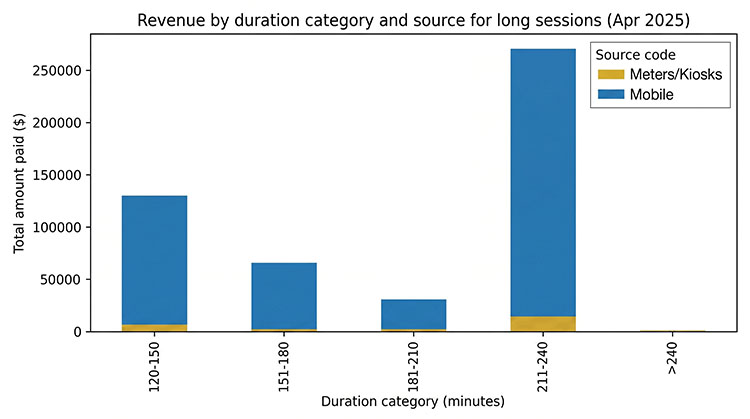
However, short sessions still produced $196,158, nearly 30% of total revenue (see Figure 4). In fact, the 31-to-60-minute category and the 61-to-90-minute category together generated more than $125,000. It turns out that high turnover pays, while fair pricing could attract even more short-term parkers.
FIGURE 4: Revenue by duration category and source for short sessions.
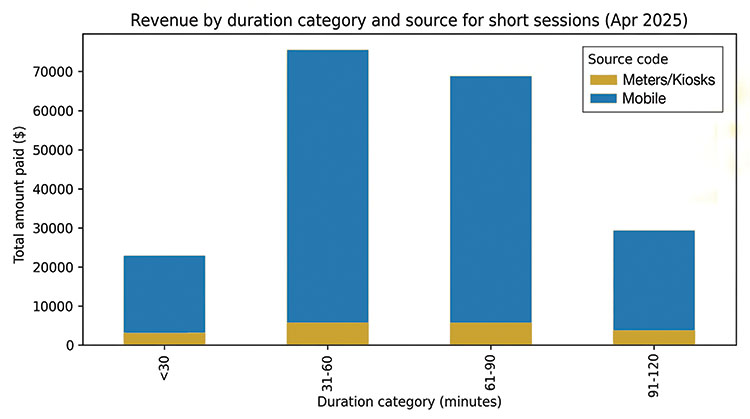
Notably, mobile payments accounted for 92% of all sessions, while traditional meters contributed only a small fraction of revenue, about 4% in long sessions and 10% in short ones. Drivers have already chosen convenience. The system simply hasn’t caught up.
Parking is not the first industry to face this moment
If this story sounds familiar, it should. The parking industry is not unique. It is simply late to a transition others have already made.
Music once insisted consumers buy entire albums for a single song. Movies once relied on late fees as a revenue safeguard. Both industries feared that unbundling and convenience would destroy profitability. Instead, they discovered something counterintuitive: Fair pricing increased participation.
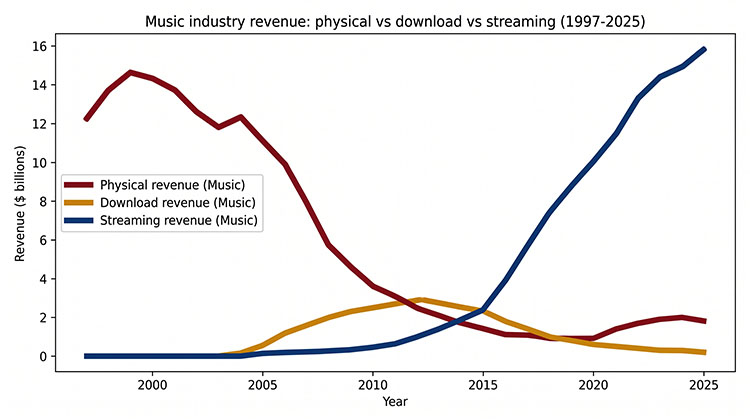
When music moved from $18 CDs to 99-cent downloads and streaming, piracy declined and revenue rebounded (see Figure 5). Physical revenues plummeted after the late 1990s. Download revenues peaked in the 2010s but quickly declined as consumers switched to streaming. By 2025, streaming accounted for almost 89% of music revenue.
FIGURE 5: Music industry revenue (1997–2025).
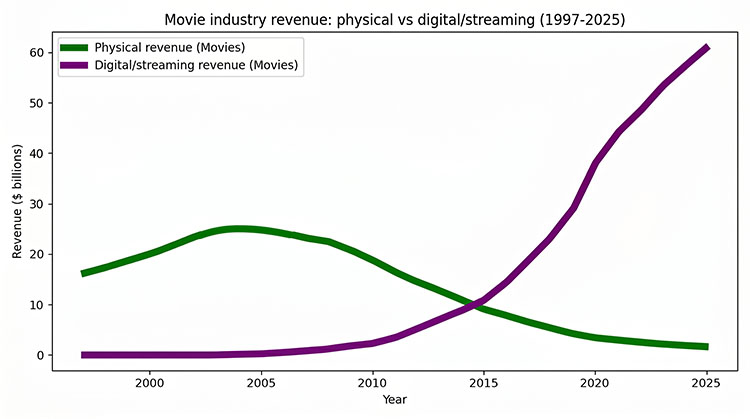
When movies switched from DVD rentals to streaming, late fees disappeared, and profits soared (see Figure 6). Physical rental and sales revenue declined steadily while digital/streaming revenue rose from nearly zero in 1997 to more than 95% of total revenue by 2025. Netflix subscribers grew from zero to hundreds of millions during the same period (data not shown).
FIGURE 6: Movie industry revenue (1997–2025).
The common thread wasn’t technology alone. It was alignment with how people actually behave.
What parking can learn
The lesson from music and movies is not about disruption. It’s about trust.
Consumers reward convenience. When compliance is easy, people comply. Fair pricing increases participation. When people don’t feel trapped, they don’t rebel.
Digital systems close loopholes. Verification replaces guesswork.
Better data leads to better policy. Real-time insight enables smarter enforcement and pricing. Location-aware, pay-only-for-what-you-use parking systems remove the need for parkers to gamble.
Drivers start a session when they park and stop it when they leave. They pay for what they used, no more, no less. Parking Saints no longer have to choose between fairness and fear.
The road ahead
The music and movie industries once asked the same question many municipalities ask today: “If we stop forcing people to overpay, won’t revenue collapse?”
The data answered that question decisively. Revenue didn’t collapse. It grew.
Parking now stands at the same inflection point. Technology exists to price parking fairly, verify location automatically, and enforce policy without confrontation. Cities that embrace this shift won’t lose revenue. They’ll replace resentment, loopholes, and guesswork with trust, compliance, and sustainable growth.
With emerging cellular vehicle-to-network (C-V2N) and cellular vehicle-to-everything (C-V2X) technologies, parking will soon function like E-ZPass for the curb: automatic, frictionless, and fair. And when that happens, Parking Gamblers and Rebels won’t disappear. They’ll simply become Parking Saints.
JERRY GREEN is the president and chief information officer of Caryl Technologies LLC. He can be reached at [email protected].