



Relocatable parking structures use modular construction to address uncertain demand, enabling facilities to be disassembled and rebuilt at different locations.
By Todd Drager
Planning for structured parking has never been simple. Designing a facility that meets today’s needs while anticipating the demands of decades in the future has always been a balancing act. Stakeholder priorities shift, master plans evolve, and outside influences — from urban growth to policy changes — reshape demand. Today, the outlook is even murkier. The rise of automation, the growth of transportation network companies, and ongoing debates about long-term parking needs have made forecasting more speculative than ever. Owners are forced to look further into the future and make educated guesses about how much parking will be needed and where it should be located.
One emerging tool in this uncertain landscape is the relocatable parking structure. Although modular garages have existed in the U.S. for years, they have typically been limited in size and duration and deployed for smaller short-term needs, such as accommodating parking displaced by construction or supplementing capacity during a major event.
However, a much larger example recently entered development at Ronald Reagan Washington National Airport (DCA), in Arlington, Virginia. The project — a 1,500-space relocatable garage, the first phase of which is scheduled to open in early 2026 — may signal the start of a new era in parking construction.
No clear-cut definition
So, what exactly is a relocatable parking structure? Similar terminology already exists, including temporary, modular, prefabricated, hybrid, and now relocatable, which is also known as demountable.
Starting in the 2018 edition, the “International Building Code” (IBC) from the International Code Council included requirements for relocatable buildings. In Chapter 31: Special Construction, the IBC defined the term as structures intended to be reused multiple times and transported to different building sites. This is notably different from the term temporary structures, which refers to those erected for 180 days or fewer.
The U.S. Department of Defense (DOD) has a slightly different requirement for what constitutes relocatable government facilities. Issued in June 2022, the Department of Defense Instruction 4165.56, titled “Relocatable Facilities,” indicates that such facilities differ from “real property” by forgoing foundations and have a “standard time of use” not to exceed seven years.
Despite these examples from the IBC and the DOD, no clear-cut definition of relocatable parking structure exists. Although owners may have their own interpretations of what makes a structure relocatable, these definitions share the general notion that the structure should be able to be disassembled and rebuilt in large part elsewhere, preserving much of its value for a second use.
Key concepts
Achieving that flexibility for large-scale garage installations depends on a few design strategies, including the use of hybrid and modular construction. The key concepts are weight reduction, flexibility, and construction redundancy. Lighter structures require smaller foundations, reducing the material lost in relocation. Construction redundancy makes for a simpler installation, but more importantly, standardized pieces facilitate flexibility in a second use. Hybrid and modular construction are great fits for these end goals.
For standard long-span garage structures, the total foundation load depends largely on the self-weight of the structural system. The use of hybrid steel construction replaces heavy concrete beams, columns, and shear walls with lighter steel framing and can reduce a typical floor load by 50% or more compared to more conventional garage construction.
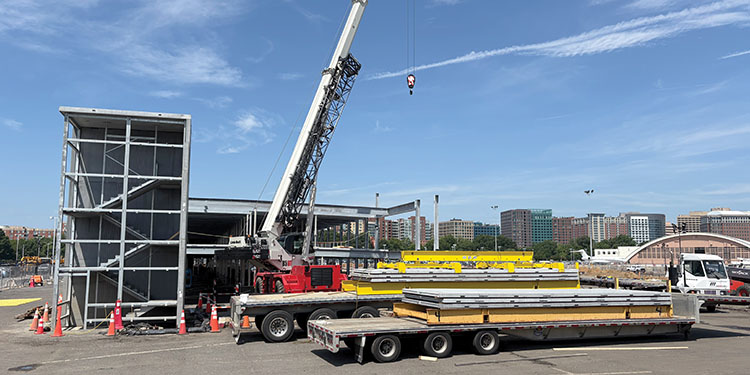
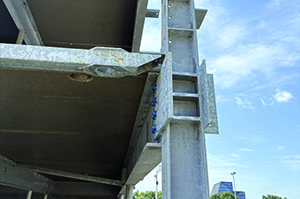
Prefabrication, or modular construction, plays a central role as well, producing uniform slabs and walls in controlled environments that can be removed and reassembled more easily. Bolted steel connections are another necessity: Whereas bolts can be unscrewed, welded joints need to be broken.
Trade-offs
However, not every component can be reused. Cast-in-place elements such as foundations, slabs-on-grade, retaining walls, and elevator pits are generally lost after the first installation. Surface-applied finishes, including coatings, sealants, and paints, are typically damaged during removal, and warranties do not carry over. Even with careful dismantling, some waste is unavoidable.
Still, much can be salvaged. Precast slabs, bolted beams, stairs, handrails, piping, and conduit often withstand the relocation process and can serve again in a second installation. The economic benefit lies in this reuse: Some builders estimate savings of up to 50% on the second build compared with a new conventional garage. However, it’s important to note that these savings remain largely theoretical, as large-scale relocation projects have yet to be conducted.
There’s also an obvious environmental benefit in reusing components. Less production and less material waste result in less carbon emissions and improved sustainability.
Relocatable garages can carry trade-offs beyond the financial. To minimize foundations, some systems avoid long-span construction, introducing additional columns that reduce efficiency and obstruct sight lines. Durability can also be a concern. Traditional precast or post-tensioned garages are built for lifespans of 50 years or more, with extensive waterproofing and protective systems. Relocatable garages, by contrast, often forgo some of these features to enable dismantling, potentially shortening their service life.
Aesthetics is another consideration. Most relocatable designs prioritize function over form, which may not suit every owner’s expectation for a prominent campus or civic setting.
A good fit for airports, universities
Where, then, are these structures most useful? Airports are a natural fit, with their expansive surface lots and frequent disruptions from construction projects. Another added benefit to airport projects is that the smaller foundations inherent with relocatable structures can minimize conflicts with the usual maze of subsurface utilities.
Universities can also benefit, especially where athletic events or evolving campus plans create fluctuating parking demands. Healthcare systems and municipalities may find relocatable garages valuable when land is scarce or long-term development plans remain in flux.
Reagan National Airport’s relocatable facility
Relocatable garages are easier to get buy-in from a range of stakeholders when the future is uncertain. The Metropolitan Washington Airports Authority (MWAA) operates both the Reagan National Airport and the Dulles International Airport (IAD) in Dulles, Virginia. Over the years, external factors have shifted airline traffic between these two airports, and this uncertainty in long-term demand is still at play today.
Credit: O&S Associates
For Reagan National Airport, land constraints and overcrowding have long been a concern. These constraints, coupled with congressional proposals to increase the number of flights to DCA, have created an inexact future at the airport. If additional air traffic is added to DCA, parking challenges will only increase. Conversely, if the MWAA is able to shift more flights to the nearby Dulles airport, parking demand would drop at DCA but increase at IAD. This large unknown created an atmosphere in which flexibility became key.
To this end, a relocatable parking structure enables the authority to add 1,500 new parking stalls to the economy lot at DCA without fully committing to the final site location, or even airport, today.
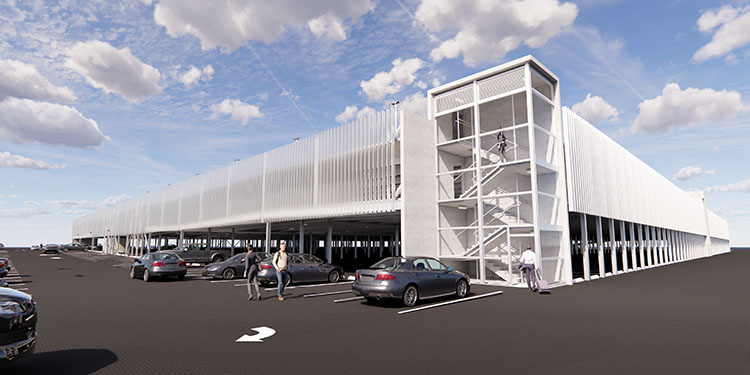
Currently under construction, the first phase of the new relocatable garage at Reagan Airport is on schedule to open in early 2026. Two supported tiers of parking are being placed on top of the existing surface parking on the east side of the existing economy lot, which is farthest from the entrance. In its final condition, the garage will be seven bays wide and nearly 500 feet long, with six stairs and two elevators. The garage will have two express ramps to enable drivers to quickly access the two structured tiers. The facility also is designed to accommodate a future parking guidance system to aid further with navigation. Surface parking will be reconfigured around the garage along with drive lane and bus re-routing to accommodate the new pedestrian destinations.
The garage is long-span but limits the single-use foundation sizes by distributing the load across a greater number of steel columns, which can be salvaged in a second use. Bolted connections are used throughout the structure as well to enable disassembly and reuse in the future. The lateral resisting system is composed of steel cross braces in lieu of their single-use counterpart in shear walls. Steel beams and precast planks are standardized, so they can be removed, stored, and rebuilt in the future.
Because this project challenged the design and construction teams to reimagine how a parking structure could be built, close collaboration throughout design was needed to turn the idea of relocatability into reality. For the project, Kiwi Newton is the design-build contractor, O&S Associates is the architect, Thorton Tomasetti is the structural engineer, and ads Engineers is the mechanical, electrical, and plumbing engineer.
Like construction itself, the parking structure form continues to evolve. What began as utilitarian car barns a century ago became standardized precast and post-tensioned garages, then mixed-use facilities designed with adaptability in mind. Relocatable garages may not yet be the universal answer, but they represent a promising option for owners seeking flexibility in a rapidly changing landscape.
Todd Drager is director of parking design services for O&S Associates. He can be reached at [email protected].