



Electric vehicle batteries that fail through thermal runaway present unique risks to parking garages and their occupants.
By Pawel Woelke, Juan Londono and Peter Johnson
Editor’s note: This article is the first in a two-part series examining the risks associated with lithium-ion batteries in parking garages and other confined spaces and evaluating approaches for attempting to minimize these risks. Part 1 below examines the potential mechanisms by which a lithium-ion battery can enter thermal runaway, a failure mechanism that releases toxic, flammable gases and can lead to a fire and possibly an explosion. Part 2, which will appear in a future issue of Parking Today, will examine methods for addressing such risks in existing as well as planned parking garages and similar facilities.
Lithium-ion battery (LiB) technology has been around since the 1990s. In fact, the 2019 Nobel Prize in Chemistry was awarded to three scientists for their contribution to the development of LiBs. Today, LiBs are central to the electrification of transportation. They are also necessary for the expansion of intermittent energy generation, electrical grid upgrades, and overall energy resilience. Now, with the global focus on decarbonization and the advent of electric vehicle (EV) technology, greater attention is being paid to the risks of LiBs to people, buildings, and infrastructure, especially in urban areas.
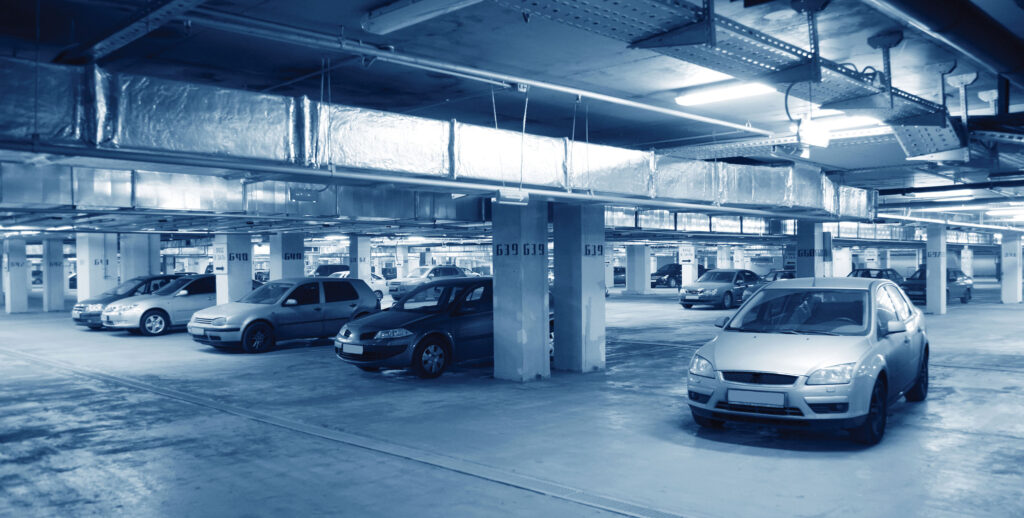
The widespread use of LiBs can have potentially catastrophic consequences in confined spaces such as parking garages, underground garages, vehicle storage spaces, uninterruptible power supply rooms, and battery testing laboratories. As EVs are often stored in multi-story or high-rise parking garages, it is critical to assess the risks of existing spaces as well as those in the concept and design stage, when it is much easier, and more cost-effective, to mitigate the risks.
With research in the early stages, changing technology, rapid EV adoption, and limited data on aging EVs, it is difficult to assess the risk. As a result, comparisons between fire risks associated with EVs and internal-combustion-engine vehicles should be made cautiously. A precautionary approach is recommended, focusing on potential consequences and incorporating them into design considerations.
Understanding thermal runaway
LiBs fail through a mechanism called thermal runaway, in which the battery releases toxic, flammable gases that can be ignited with a relatively minor energy input. During thermal runaway, uncontrolled, self-sustaining exothermic chemical reactions — that is, chemical reactions that release energy — inside the LiB cell produce significant amounts of heat and flammable, toxic off-gas that can propagate, causing an explosion, fire, or both.
The multiple causes of thermal runaway in a LiB cell include overheating, overcharging, and mechanical abuse. In the event of an electrical short, the temperature inside the cell rises, causing the exothermic, or heat-releasing, electrode reactions to accelerate, producing even more heat and further increasing the reaction rate. The temperature increase causes the internal pressure to rise, triggering safety venting through the battery’s pressure release valve. Despite the pressure relief, the process continues to accelerate in most cases, releasing flammable and toxic vapors, visible as white or gray smoke.
Multiple ignition hazards
Thermal runaway can also be initiated without any overheating, overcharging, or mechanical damage. The main components of LIBs are the anode, cathode, separator, current collectors, and electrolyte. As LiBs age, crystals called dendrites can form at the cathode-electrolyte interface and grow large enough to cause an electrical short.
During thermal runaway, a layer between the anode and electrolyte solvent called the solid-electrolyte interphase breaks down. The cathode decomposes,
and oxygen is released. This oxygen sustains the exothermic reactions inside the cell; therefore, no external oxygen supply is needed. Unfortunately, this makes many fire suppression methods ineffective for LiB fires.
The battery off-gas is usually ignited either by the high temperatures of the cell surface or from sparks emitted from the cell. Occasionally, the off-gas remains unignited. Unignited off-gas is most often associated with lithium-iron-phosphate (LFP) batteries, which have a less vigorous thermal runaway than other LiBs, such as nickel-manganese-cobalt (NMC) batteries. In confined spaces, the ignited off-gas quickly consumes the limited oxygen available and continues to be emitted as unignited off-gas. This process can lead to multiple ignitions and deflagrations — that is, delayed ignition of flammable off-gas.
The engineering challenge ahead
The hazards in an existing parking garage include the thermal load on the building caused by the thermal runaway and subsequent EV fire; the effects of an explosion on the building and any nearby people; and the toxicity hazard, which is two-fold, as it concerns not only smoke from the fire but also the unignited battery off-gas. Ventilation rates also affect the severity of the fire, deflagration, and toxicity hazards. So, too, do overpressure relief systems, such as pressure relief panels, which open once a threshold pressure has been reached, to reduce pressure build-up and provide a vent path for the explosion.
Although thermal runaway risks are real and significant, they are not insurmountable. The same engineering ingenuity that made LiBs central to our electrified future can be applied to managing their hazards, ensuring that our transition to sustainable transportation enhances rather than compromises public safety.
PAWEL WOELKE is the applied science practice co-leader, JUAN LONDONO is an associate principal, and PETER JOHNSON is a senior associate at Thornton Tomasetti. They can be reached at [email protected], [email protected], and [email protected].