



Automated monitoring and enforcement systems enable small lot owners to boost monthly revenue while dramatically increasing property values.
By Jay Landers
For property owners with small parking lots, the economics of monetization have traditionally been challenging. Installing gates and barriers typically requires substantial upfront investment that often exceeds the revenue potential of modest facilities. Meanwhile, hiring staff to conduct enforcement also can be costly. This economic reality has left countless small lot owners watching prime downtown and tourist-area parking remain underutilized by paying customers while serving as free vehicle storage for non-patrons, a frustrating situation that also represents significant unrealized value.
The recent emergence of cost-effective automated monitoring and enforcement technology is changing this calculation dramatically. License plate recognition (LPR) cameras, wireless communication systems, and cloud-based management platforms now offer a workable solution that can transform small lots into revenue-generating assets without the prohibitive infrastructure costs of traditional approaches. Property owners who have made this transition are reporting payback periods measured in weeks rather than years, along with substantial increases in property valuations that far exceed their initial technology investments.
Developer deploys detection technology
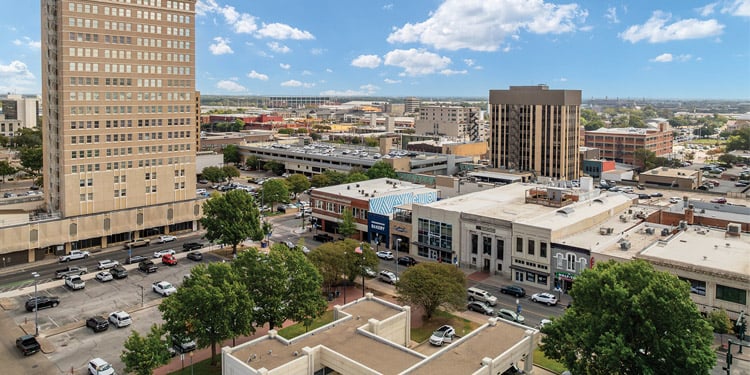
Steve Sorrells owns property in the central business district of Waco, Texas, not far from where the TV personalities Chip and Joanna Gaines opened their shopping complex, the Magnolia Market at the Silos, in 2015. Since then, as growing numbers of visitors have flocked to the market, “downtown Waco has just become a tourist mecca,” said Sorrells, president and CEO of Sorrells and Company, LLC, a residential design and construction firm.
As visitors to the area grew, property taxes rose dramatically and demand for parking increased, two factors that made Sorrells want to monetize his modest 30-space parking lot serving mixed-use tenants and a co-working space used by more than 100 members. But how to do so cost-effectively and in a way that would not preclude future development of the site remained elusive.
“We talked about automated gates and readers and fencing and policing and all that sort of thing,” Sorrells said. “We talked about [electric vehicle] charging stations.” However, these options would have required a “fairly significant equity injection into the deal or additional debt,” he noted. Because the costs far outweighed the benefits, no action was taken.
The situation changed dramatically about a year ago, when Sorrels installed automated monitoring and enforcement technology from Municipal Parking Services Inc. (MPS) and began charging for parking. Two cameras with LPR technology were installed on poles, one at the lot’s entrance and one at the exit. As vehicles enter and leave the lot, the cameras take time-stamped images to monitor the length of time they park. The installation also included a power and communication unit that was situated on a center island adjacent to the poles. Several signs also were added to notify drivers that payment is required to park in the lot.
Unlike the more complicated approaches Sorrells previously considered and rejected, the automated approach presented a more convenient option that also would not require spending any time or effort on enforcement, he said, as that is handled by MPS, which receives a percentage of the revenue associated with each transaction. “It seemed like something that could be easily done, in a very cost-attainable way,” Sorrells said.
To accommodate the different needs of those parking at the lot, the system was designed with different ways for users to pay. The signs feature a QR code that can be used to pay to park in the lot. Meanwhile, tenants purchase discounted monthly parking permits for their employees, whose vehicle license plates are registered to ensure that they are recognized by the enforcement system. Finally, Sorrells can validate parking for his own clients visiting his office. Compliance rates hover around 95%. “This seemed to check all the boxes,” he said.
Financially speaking, the automated monitoring and enforcement system worked so well that Sorrells achieved a return of his investment in a mere 45 days. Several months later, he added a similar system to another small parking lot of his located across the street. Combined, the systems provide a new monthly income of more than $4,000 for the two lots, which total about 50 spaces, Sorrells said. “We’ve been pleased with the check we’re getting.”
The added income “more than makes up for” the property taxes on the site, Sorrell said, while also helping to defray some operational expenses associated with the parking lots. At the same time, the new revenue source “probably easily added $800,000 in value to the parking lots” based on the capitalization rate, he noted.
Bar owner’s bold move
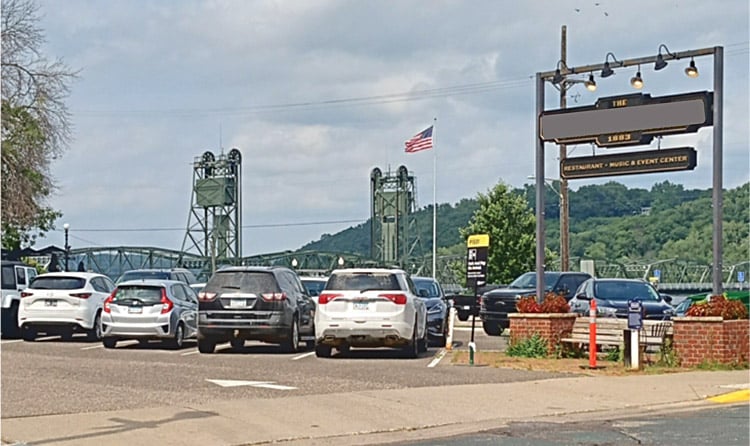
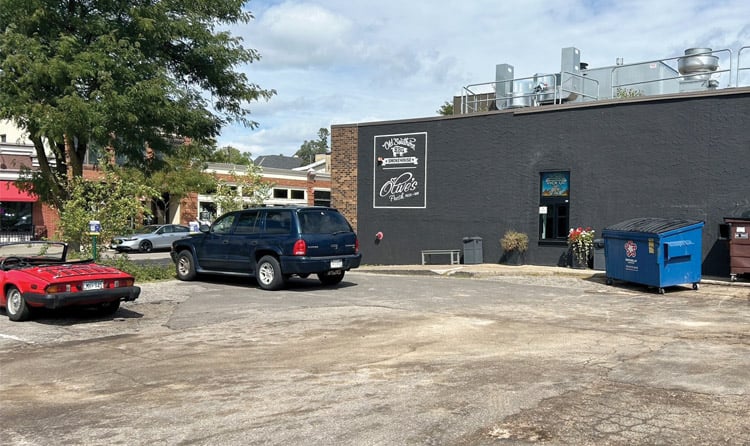
For the past 50 years, Bob Sabes has owned a bar and restaurant complex in a small suburban town outside of St. Paul, Minnesota. And for nearly all of that time, parking has been free in the 30-space parking lot that serves the establishment.
Because the town is a summer tourist destination, the lot was frequently used by drivers not patronizing the businesses on Sabes’s property, even though it was reserved for patrons. “They were used to parking there for years and getting away with it,” Sabes said.
That all changed this past June, when Sabes began operating an automated monitoring and enforcement system in his lot. “After a couple months, [parking violations] have dramatically been reduced,” Sabes said.
The installation included two LPR cameras — one positioned on the building and the other on an existing lamppost — to monitor the lot’s entrance and exit as well as power and wireless communications equipment inside the building.
Signs were posted at every third parking stall indicating that payment is required to park there, along with a large sign with the same message at the restaurant podium. “We’ve tried to go overboard on signage to reduce the complaints [from parkers] that they never saw the signage,” Sabes said.
The cost to park at the lot is essentially the same as what the municipality charges to park, and validations are not provided. Overall, the public response has been largely positive, Sabes said. “People don’t mind paying a couple bucks for convenient parking.”
This willingness to pay is especially apparent during the busy summer months, as income from the parking operations has netted more than $10,000 a month, though this amount will vary seasonally, Sabes said. “It’s the height of our busy season, so I expect that to decrease once the cold weather comes in.”
The monitoring and enforcement system paid for itself in only two weeks. In addition to the new source of monthly income, the paid parking program has boosted the value of Sabes’ property. “If I were looking to sell my property, I think we have another $1 million to $2 million in value just by the income from the parking,” he said.
Ten spaces transformed
Approximately two years ago, the property management and development firm Red Leaf Partners began charging to park at the 10-space parking lot located beside a property it owns in Excelsior, Minnesota, a small town with a population of approximately 2,400 people. The property includes a building with two restaurants and is located in the downtown area, which experiences significant demand for parking during peak tourist season.
Try as they might, Red Leaf Partners had not been able to devise a cost-effective way to ensure that parking at the lot was reserved for patrons of the restaurants. “Historically, the lot has been used by anybody who’s driving by and wants to park there,” said Jesse Nelson, a property manager for Red Leaf Partners. “We were frustrated by that,” Nelson noted. “It’s such a small space that we didn’t really have an idea of what to do. It wouldn’t be worth our time to place somebody there. Signs were ineffective.”
Implementing an automated monitoring and enforcement system solved these problems, Nelson said. With only one means of ingress and egress, the parking lot only required a single camera mounted on top of the building. “It’s pretty nondescript,” he said.
The installation also included wireless cellular connectivity to the vendor’s back-office cloud network, power and wireless communications equipment inside the building, and a power-over-ethernet system that connects the cameras to the power and data sources. At each space in the lot, signs with a QR code inform drivers of the need to pay for parking. Drivers are allotted a 15-minute grace period, and the restaurants can validate parking for their patrons.
Charging for parking has helped to improve turnover in the lot, Nelson said. “Our parking has been more open than it was previously. We have more access for the people who use our restaurants.” Compliance also “has been really high,” he said. Although some complaints occurred initially, those have faded away. “We rarely hear any feedback from anyone,” he said.
Since implementing the system, Red Leaf Partners has received an average of $1,000 in monthly income from parking revenues, an amount that varies seasonally, Nelson said. “The very first month, we got a check back. That was huge.” Another benefit has been the higher valuation of the property, he noted. “It’s good to know that that if we were valuing this building, it’s valued higher than it was before we were using this parking technology.”
The company also saw to it that its tenants benefited from the new arrangement, particularly because the parking lot previously had been reserved, at least nominally, for restaurant patrons. To this end, Red Leaf Partners uses its newfound parking income to offset some of the operating expenses that its tenants normally would have to pay for upkeep and maintenance of the lot, Nelson said.
Simple solution: start soon
Sorrells — the Waco-based developer — also highlighted the importance of patents in his decision to use the automated monitoring and enforcement technology from MPS, which holds five U.S. patents related to smart parking systems. “What stood out was the patented foundation of MPS’s technology,” Sorrells said. “That level of innovation and protection gave us confidence that the system will remain viable and valuable for the long term, which played an important role in our decision to move forward.”
Based on his positive experience, Sabes recommends that owners of small parking lots strongly consider the use of automated monitoring and enforcement solutions to monetize their facilities. “Anybody who has a parking facility that needs control or can be monetized that isn’t monetized right now, I would recommend the program,” he said. Automation “solved a problem for us that we’ve had for a long, long time.”
Sorrells has some simple advice for owners of small parking lots who are interested in taking an approach similar to his: “Hurry up and do it,” he said. “The sooner you do it, the sooner you’ll make money on it.”
JAY LANDERS is the editor-in-chief of Parking Today. He can be reached at [email protected].