


As electric vehicle (EV) adoption accelerates, the real challenges for parking design lie in layout, access, and adaptability, not structural load.
By Todd Neal
During the past several years, a growing body of research has emerged focusing on electric vehicle (EV) weights as compared to those of internal-combustion engine (ICE) vehicles. Although EV vehicles are indisputably heavier than their ICE equivalents, the implications of that added weight, along with other factors unique to EVs, are changing how we design parking facilities. As the adoption of EVs accelerates, we must reevaluate how we design for the change in structural loads as well as how we lay out these spaces to accommodate accessibility, fire safety, charging logistics, and future adaptability.
Structural loads remain unchanged in the EV era
EVs are typically 30% heavier than their gas-powered equivalent due to their battery systems. The question then becomes: Does this increased weight warrant a change to the design live load of parking structures? As defined by the American Society of Civil Engineers (ASCE) in ASCE 7, Minimum Design Loads and Associated Criteria for Buildings and Other Structures, the design live load for parking structures is based on the curb weight of the 85th percentile of vehicles on the road, with the design vehicle dimensions set by the American Association of State Highway and Transportation Officials (AASHTO).
In the article “Electric Vehicles and Parking Structures” published in the July 2024 issue of Structure magazine, authors Leslie Jo Hurwitz, Brian Fisher, and Carl Schneeman note that, from 2011 to 2023, the 85th percentile passenger vehicle curb weight remained relatively unchanged at 5,000 pounds, even with the rising number of EVs, trucks, and vans on the road. In the past 10 years, the 85th percentile has seen a modest increase of 100 pounds.
Currently, parking garages are designed for a live load of 40 pounds per square foot, as prescribed by ASCE 7. This design live load is a reduction from earlier building codes that called for 50 pounds per square foot. This change, the Structure article states, followed the publication of a paper by Y.K. Wen and G.L. Yeo titled “Design Live Loads for Passenger Cars Parking Garages” in the March 2001 Journal of Structural Engineering. They found that the actual loads in the multiple garages they studied were considerably less than the 50 pounds per square foot live load prescribed by the then-current version of the ASCE standard — ASCE-7-95. These findings were questioned but reaffirmed by Mary S. Smith and Anthony P. Chrest of Walker Consultants in a 2002 article in Concrete International titled “SUVs and Parking Structures: Is There a Weight Problem?” They concluded that in most typical parking garage layouts actual loads rarely approach the benchmark of 40 pounds per square foot.
Although EVs are indeed heavier, the sales numbers for these vehicles have not reached the point where they are significantly affecting the design weight determined by AASHTO, and actual vehicle loads remain well below the design load thresholds for parking structures. In our opinion, there is no indication that an increase in the weight of EV vehicles would be practical or desired from a manufacturing or consumer standpoint. Therefore, we anticipate the current design loads will suffice for the foreseeable future.
With the issue of vehicle weight seemingly having no current effect on the design loads of parking facilities, other design challenges associated with EVs are coming into play. In addition to the life-safety effects of EVs in parking garages, several functional effects should be considered.

One size doesn’t fit all, especially for EVs
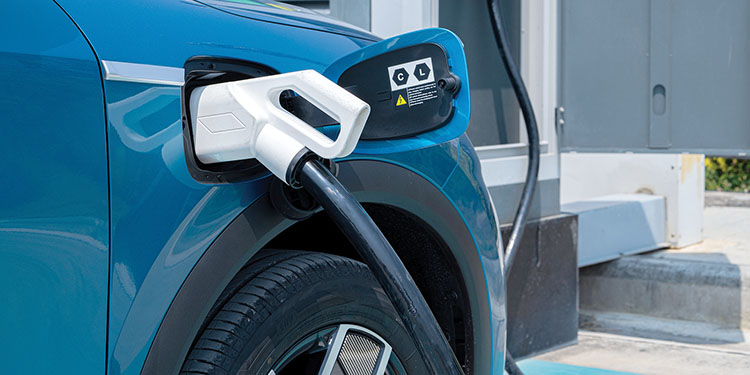
EV spaces are often clustered together, and two spaces typically share one EV charging station with dual chords. Like gas tank access in their ICE counterparts, charging port locations vary by vehicle make and model, leading to potential challenges in maneuvering and useability, especially when adjacent vehicles are parked in close proximity.
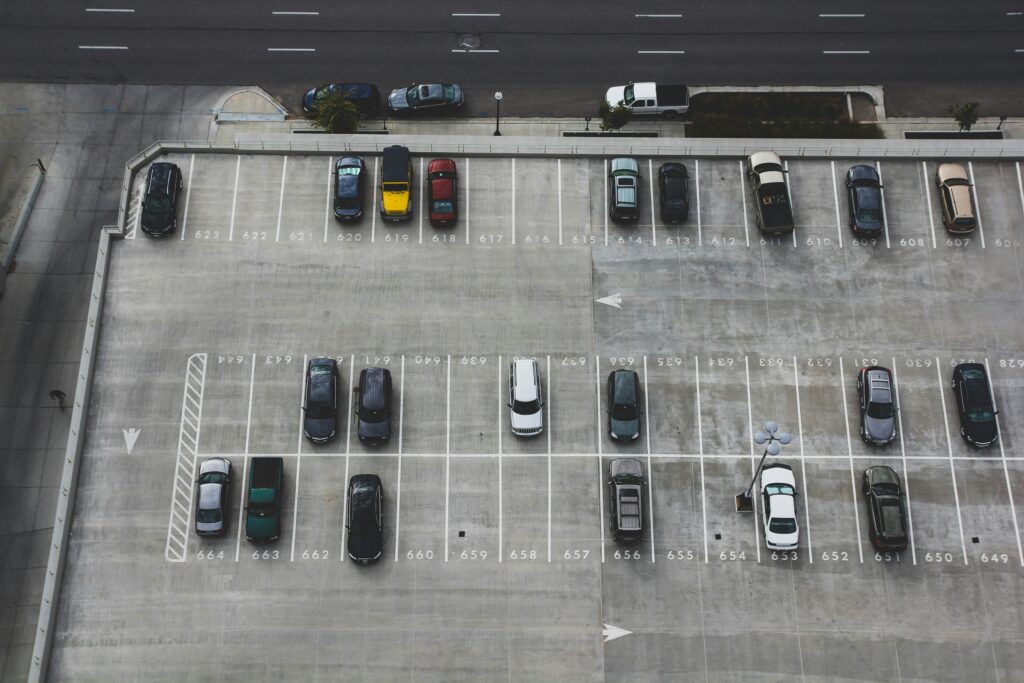
A search for standard U.S. parking space dimensions finds a broad range, from widths of 7 feet, 6 inches to 9 feet and depths of 16 feet to 20 feet. This range reflects the diversity of vehicle types and use cases, from compact cars in employee garages to full-size SUVs and trucks in retail and medical settings.
The Urban Land Institute (ULI) suggests basing the size of stall widths on turnover frequency, with narrower spaces for longer-term parking, such as in employee garages, and wider ones for moderate to high-turnover locations, for example, retail and medical facilities. Local zoning codes often call for spaces that are 9 feet wide by 18 feet deep.
With a 7-foot-wide design vehicle, 1 to 2 feet of clearance should be provided between cars. But anyone who has ever parked in a garage or parking lot knows that this is not always the case. It only takes one misaligned vehicle to disrupt an entire row of parking spaces. This situation can become even more problematic as a result of the lack of charging port standardization. To safely charge a vehicle, users may have to maneuver their way through cords and past mirrors and doors, increasing the potential of injury or vehicle damage.
Access comes at a premium
The efficiency of a parking garage is generally measured by the metric of square feet per car. For example, a 20,000-square-foot deck that accommodates 61 vehicles would achieve an efficiency of 328 square feet per car, which is well within our anticipated range of efficiency — that is, 320 to 350 square feet per car — for a stand-alone parking structure. In addition to stall sizes, other factors that pertain to a garage’s overall efficiency include travel lane widths, floor plates, ramping, and required stair cores. When only a few EV spaces are introduced into a garage layout, the reduction in efficiency is minimal. However, if we eliminate one space and use the area to increase the level of service for two EV spaces, further separating adjacent vehicles, efficiency will decrease by 4%. In a full garage conversion with each EV space widened by 1 foot, 6 inches, approximately one out of every six spaces would be lost, reducing overall efficiency by 20% or more.
Currently, no formal codes or professional guidance indicate the appropriate layout of EV spaces, other than some recommendations from the U.S. Access Board, an independent federal agency that issues accessibility guidelines. In 2023, the U.S. Access Board released a document titled “Design Recommendations for Accessible Electric Vehicle Charging Stations,” providing recommendations for an accessible charging station. Although not legally binding, the guidelines recommended a space 11 feet wide by 20 feet deep with an adjacent 5-foot-wide access aisle. This recommendation enables full access to both sides of a vehicle, creating an accessible route to the charging station. Compared to the current requirements of the Americans with Disabilities Act for van space, this recommendation is a 45% increase in area per space. The extended depth also will present a challenge to maintain efficiency and standard garage bay widths.
Although the discussion about the weight of EVs continues, the functional effects of accommodating EVs, such as layout, efficiency, accessibility, and safety, present more pressing challenges for designing parking structures. As codes and accessibility guidelines catch up with the growing market for EV vehicles, we expect to see garage designs trending toward larger spaces, with an improved level of service that reduces the risk of potential injury or vehicle damage.
TODD NEAL is a principal in the Portland, Maine, office of Thornton Tomasetti. He can be reached at [email protected].