Advanced ceramic printing technology transforms a 600-space Arkansas garage into a canvas celebrating the Caddo Nation’s cultural legacy.
By Bill Smith
When the Crystal Bridges Museum of American Art and its annex The Momentary, in Bentonville, Arkansas, planned a new parking facility, the institution wanted to create a structure that could also serve as an extension of the museum itself. Museum administrators chose to commission a structure that would carry a deeper cultural and architectural significance — one that honors the heritage of the land and the people who live on it. The result is a striking synergy of art, architecture, and cultural memory: a parking garage whose facade is transformed into a monumental canvas.
A purposeful collaboration
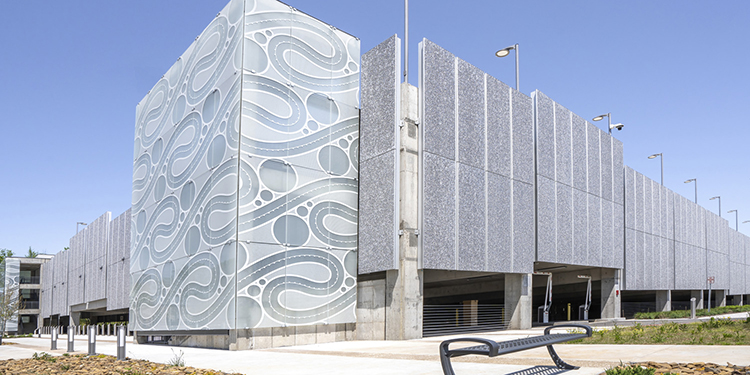
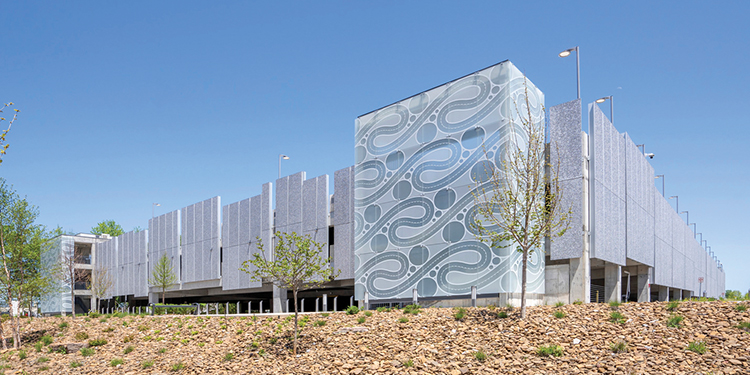
The project involved a collaboration between the Chicago-based architectural firm Wheeler Kearns Architects, which had also designed The Momentary, and Chad “Nish” Earles, artist and member of the Caddo Nation. Earles was invited not simply to decorate a wall, but to craft a design concept deeply grounded in Indigenous identity, heritage, and continuity. The design, titled “Above & Below,” is permanently featured on the glass scrim of the parking structure.
Earles’ design references motifs in pottery created by his ancestors — a visual language that speaks of both the land and the people. At the same time, the project’s architects sought a material expression that could serve the functional demands of a parking structure, including ventilation, durability, and weather protection, while also offering an aesthetic of openness and lightness.
The Caddo people’s ancestral territory spans what is now northeast Louisiana, east Texas, southwestern Arkansas, and southeastern Oklahoma. Their pottery tradition is renowned: Beginning around A.D. 800, Caddo potters created vessels often mixed with freshwater shells, burnished and intricately incised, used for both day-to-day and ceremonial purposes.
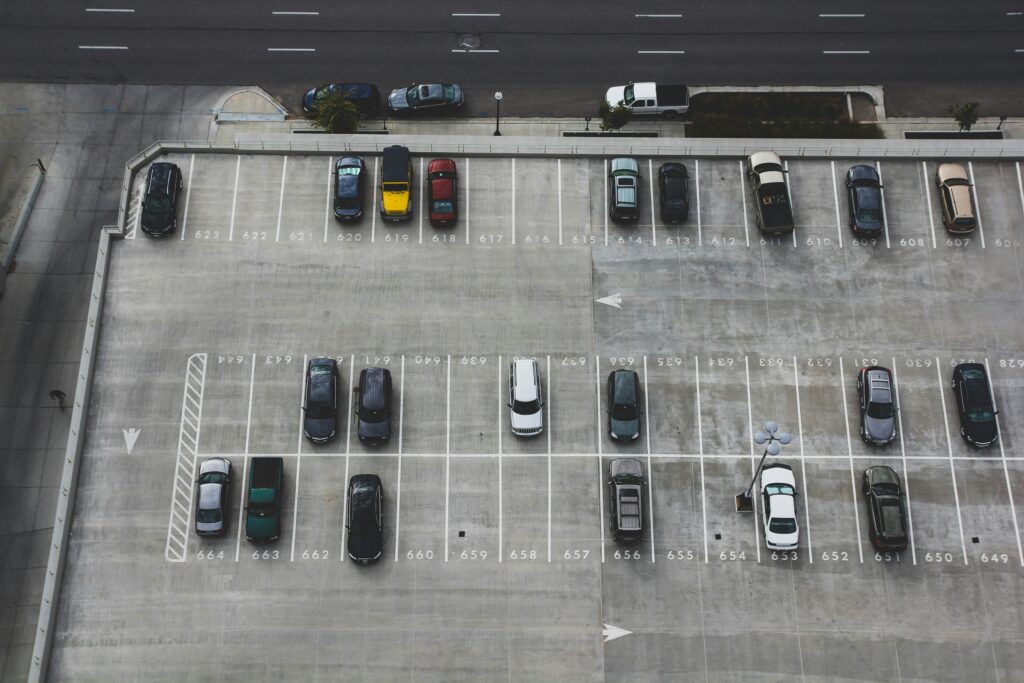
“Above & Below” draws on that heritage. As Earles put it, the name speaks to the idea that the Caddo people are “still here today, above and below the ground.” Presented on a three-level parking garage of approximately 600 spaces, the work signals a departure from the typical utilitarian design of concrete. Instead, the garage becomes an artistic expression of culture made public and architectural.
Material innovation meets cultural vision
To realize Earles’ design concept on such a scale and for such a structure, the team turned to the glass company Bendheim LLC and its Design-Assist Group. Bendheim has provided architectural glass for some of the industry’s most notable museum projects, including the Nelson-Atkins Museum of Art, in Kansas City, Missouri; the National Museum of African American History and Culture, in Washington, D.C.; and the Museum of the Bible, also in Washington, D.C. The company also provided colored art glass for the renovation of the Statue of Liberty’s illuminated torch and its mouthblown Restoration Glass® for the White House, Mount Vernon, and Monticello.
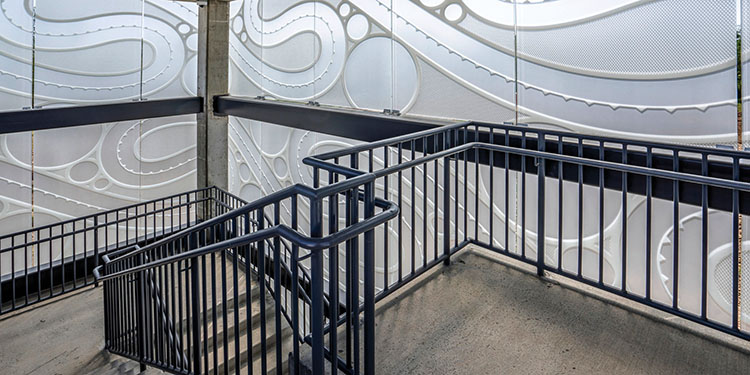
Bendheim was tasked with developing a ventilated glass facade to act as a canvas for Earles’ artwork, one that would be uninterrupted by visible hardware. To that end, the opaline patterns on the panels were permanently fired into the glass. Bendheim utilized a digital print process known as ceramic frit printing to apply ceramic inks fused into the glass surface during the tempering process. The result is a permanently durable, ultraviolet-stable image on a transparent sheet of safety glass.
“Ceramic frit printing was the perfect approach because it will last forever,” said Steven Jayson, a partner at Bendheim Glass. “Digital ceramic ink is the modern equivalent of the painted images on colored glass that we see in the classic churches of Europe,” Jayson said. “It will retain its vibrant color for centuries, with virtually no maintenance.”
Fusion of art and infrastructure
Bendheim’s rainscreen system, known as the Wall-F Compression system, enabled the panels to be installed with no visible vertical supports between them, giving the facade an uninterrupted, flowing quality. The visibility, light transmission, and reflectivity of the glass amplify the design’s effect. In this way, the glass enables visitors to “see the sky, the sun, the moon, the trees, and the land around it,” Earles said.
Functionally, the system does far more than look beautiful. The glass panels act as a ventilated facade or rain screen, shielding travelers in the parking structure from the elements while facilitating the passage of daylight and natural air movement within the structure, both important features for a parking garage. The fusion of art and infrastructure serves both expressive and functional goals.
Wheeler Kearns’ design ensured that the garage would integrate with The Momentary campus and function seamlessly. “For the parking garage, we worked with Chad ‘Nish’ Earles to develop signifying elements within the fluted glazing that were taken out of the culture of the landscape where they originated,” said Dan Wheeler, a principal for the firm.
The structure’s design went beyond providing parking; the building had to support the public art campus, the adjacent festival, performance functions of The Momentary, and the broader Market District in Bentonville. The garage also opens the infrastructure of the museum campus to the public, providing free parking for visitors and the local community.
Meaning and lasting impact
What might normally be treated as a background building — a parking garage tucked in the corner of a campus — has been elevated into something participatory and visible. For the Caddo Nation, and for visitors to Bentonville, the work quietly asserts presence, reflecting the Nation’s culture on ancestral lands.
On an urban planning level, this project exemplifies a growing trend of treating infrastructural buildings as opportunities for storytelling, identity, and place-making. Each layer of decision-making in this project — the material, the method, and the motif — is aligned to respect history while meeting contemporary demands.
In “Above & Below,” the collaboration among the Crystal Bridges Museum of American Art, The Momentary, Wheeler Kearns Architects, Chad “Nish” Earles, and Bendheim demonstrates how architecture, art, and culture can converge to produce something exceedingly special. A parking garage becomes a canvas that reflects Indigenous heritage and the artistic reflection of the museum itself, while serving as an essential piece of infrastructure.
BILL SMITH is a business writer who specializes in the parking industry. He can be reached at [email protected].