



Engineering solutions can manage fire and explosion risks from electric vehicle (EV) batteries in parking structures.
By Pawel Woelke, Juan Londono and Peter Johnson
Editor’s note: This article is the second in a two-part series by the authors examining the risks associated with lithium-ion batteries in parking garages and other confined spaces and evaluating approaches for attempting to minimize these risks. Part 1, titled “When Lithium-Ion Batteries Fail,” appeared on pages 24-25 of the August 2025 issue of Parking Today.
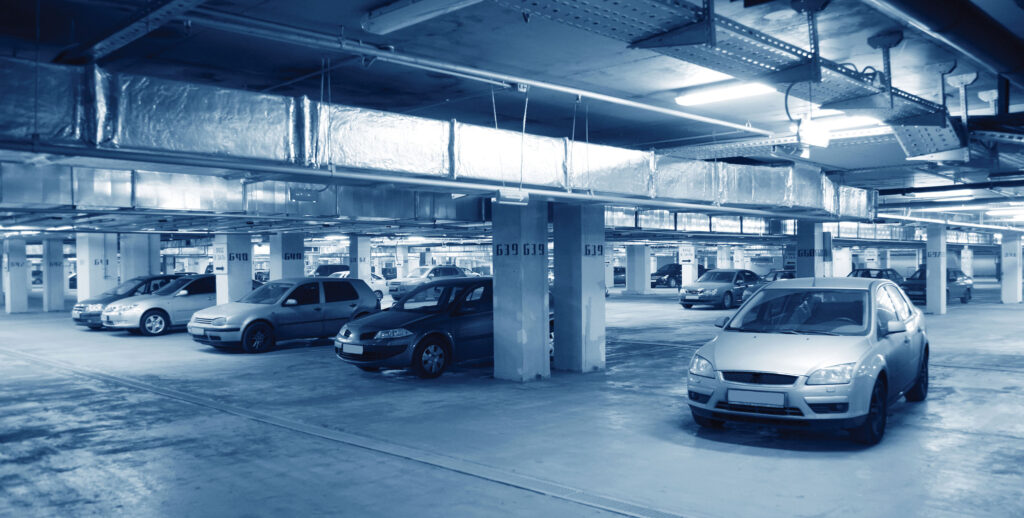
As EVs continue to gain in popularity, they confer both environmental promise and engineering challenges. The lithium-ion batteries that power them pose inherent risks of explosion and fire. The risks are highest when EVs are stored in close quarters such as multi-story or high-rise garages, underground garages, and other battery storage areas. As our understanding of these hazards evolves, so do building codes, standards, and design guidelines.
Although new construction offers the opportunity to mitigate risks at the design stage, steps can also be taken to retrofit existing structures to make them safer. An initial step is simply to control the use of counterfeit, or knock-off, lithium-ion batteries, some of which may not meet any recognized safety standard.
Engineering approaches can address the risks of fire and explosion through targeted design strategies. Although fire and explosion present different challenges requiring different solutions, effective mitigation must address both risks simultaneously. Ventilation design, structural considerations, and operational measures can significantly reduce the likelihood and severity of lithium-ion battery incidents in parking facilities.
How lithium-ion batteries fail
Lithium-ion batteries can undergo thermal runaway — that is, a chain reaction in which the battery releases toxic, flammable gases that can be easily ignited. If ignition occurs early in the thermal runaway process, a fire can result. If ignition happens later in the process, flammable off gas produced by the battery can accumulate and cause an explosion.
Parking structures are particularly at risk when EVs are charging, as that process increases the likelihood of initiating thermal runaway. Because fire can develop suddenly and rapidly, spacing between vehicles should be increased wherever possible.
Explosion hazard and mitigation
Ventilation, both passive and mechanical, is the primary means of minimizing the likelihood and build-up of flammable off gas in enclosed spaces. Passive, or natural, ventilation is strongly dependent on the geometry of the parking structure, including its openness and ceiling height, the prevailing wind direction and speed in reference to the building, and many other factors. These factors highlight the need for coordinating different disciplines during the design process. For example, the facade elements of a parking structure, its openness and orientation, have a direct effect on ventilation.
Mechanical ventilation can be tailored to a specific facility regardless of its openness. At the extreme level, although often impractical, the purge rate of ventilation, at which no accumulation of flammable gas occurs, can be determined and designed. In this case, the ventilation system could operate at a reduced capacity until thermal runaway is detected, triggering the purge rate. This approach requires a lithium-ion battery off-gas-detection system, which could be calibrated for a specific off-gas component — for example, hydrogen — or typical gas mix. Even if an explosion occurs, circulating fresh air can dilute the flammable gas, reducing the severity of the blast. However, no one-size-fits-all rule exists. Whether designing a new parking garage or retrofitting an existing one, the specific means of increasing ventilation depend on the dimensions and layout of the structure.
Two factors that significantly affect an explosion are congestion and confinement. Congestion refers to physical obstacles in the flammable gas cloud. When an expanding gas cloud encounters an obstacle, turbulence results, which in turn accelerates the rate of combustion. In the extreme case, the flame speed can exceed the speed of sound, causing detonation and a shockwave. (A subsonic flame speed causes the more gradual combustion process known as deflagration.) Reducing congestion in the area of potential release is an important mitigation tactic.
Confinement refers to the presence of solid obstacles that prevent hot gases from expanding. If expansion is completely unconstrained, the pressure of the gases would not rise significantly. At the other extreme, an explosion within a fully confined space has no room in which to expand as the temperature of the gases rise. As a result, the walls of the space will experience a pressure increase above normal atmospheric pressure referred to as an “overpressure.”
Consequently, pressure relief panels can be an effective mitigation measure for explosions that occur within confined spaces. These are panels integrated into walls and/or ceilings that open at a predefined overpressure. Once open, they enable hot gases produced by an explosion to vent out of the confined space, limiting the pressure rise within. These relief panels must be carefully designed for specific conditions to maximize their effectiveness in reducing the explosion pressure and ensuring the overall functioning of the building. In general, the risks posed by congestion and confinement suggest the need to limit any physical fire barriers in the area of release, if possible.
Together, ventilation and the reduction of congestion and confinement can reduce the overpressure associated with an explosion. Once these measures have been designed and optimized for a particular scenario and constraints, the final mitigation layer involves designing all other critical building elements to resist any remaining explosion overpressures. All these mitigation layers must take into account the fire hazard, with the specific objective of ensuring that the explosion mitigation does not increase the fire risk.

Fire hazard and mitigation
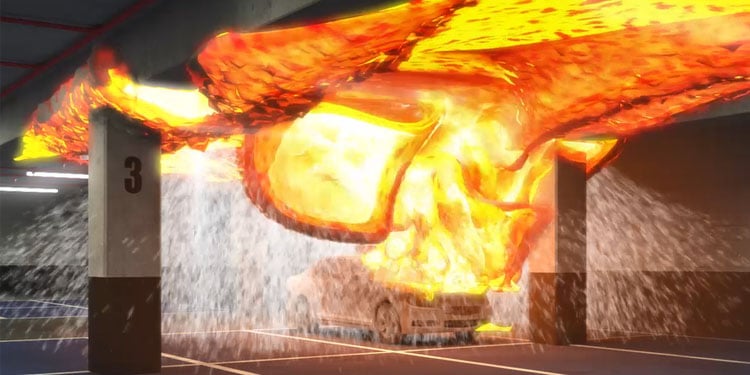
If gases ignite before accumulating, fire is more likely to occur than an explosion. Because lithium-ion batteries contain oxygen that is released during combustion, the thermal runaway process can continue without an external supply of oxygen. This often results in reignition after the external fire has been extinguished. The only way to eliminate the fire hazard is by preventing or stopping thermal runaway, which requires lowering the battery temperature to the point where the internal exothermic reactions are stopped or sufficiently slowed. Although active fire suppression systems able to achieve that goal are being developed, they are not yet readily available.
The main suppression tactic, to immerse the entire battery in water, is impractical in buildings. Short of that, sprinklers are the most effective means of fighting an external battery fire. The key measure of sprinkler effectiveness is the density of water application — in other words, gallons per minute per square foot. In structures housing EVs, application rates above those typically called for by codes and standards — for example, the “NFPA 88A Standard for Parking Structures” published by the National Fire Protection Association (NFPA) — should be considered as a precautionary measure.
One of the most important considerations with fire is to prevent its spread across the entire parking garage or the floor. In the case of hydrocarbon fire, separation of vehicles such as by individual parking stalls would effectively prevent fire spread. Unfortunately, this would increase confinement and congestion, exacerbating the explosion risk. This example illustrates the complexity of the problem and the need for a comprehensive risk assessment for any large battery-housing facility.
As in the case of explosions, structural design considerations need to include the fire condition as one of the load cases. Given the intensity of the fire and its temperature, exposed steel elements or metal decks should be avoided, especially in garages with low ceilings, unless designed with enhanced fireproofing. Reinforced-concrete systems are preferred, with additional measures aimed at preventing or limiting concrete spalling under high temperature.
Managing lithium-ion battery hazards
For environments that present increased risks because of their location, layout, or proximity to sensitive items, a detailed assessment followed by dedicated mitigation measures can provide a pragmatic, robust approach to dealing with lithium-ion battery hazards. Depending on the structure, a variety of options may be available. Though ventilation rates, for example, can be improved through mechanical means, a cheaper and more effective option might be to increase the openness of the parking garage facade.
Unfortunately, the multi-hazard nature of lithium-ion battery thermal runaway greatly complicates preventative and emergency measures. As noted earlier, individual parking stalls for EVs could help prevent the spread of fire but significantly increase the risk of explosion.
Because EVs represent a relatively new type of risk for the built environment, standardized solutions are limited or nonexistent. Each parking garage presents a unique set of challenges. Once the hazards have been identified and their likelihood assessed, safety engineers can develop detailed mitigation plans for that structure.
Pawel Woelke is the applied science practice co-leader with Thornton Tomasetti. He can be reached at [email protected]. Juan Londono is an associate principal with Thornton Tomasetti. He can be reached at [email protected]. Peter Johnson is a senior associate with Thornton Tomasetti. He can be reached at [email protected].