


By Katherine Beaty
I’m almost 50. (Nope, still in denial. Please don’t bring it up.) Lately, though, I’ve gotten serious about physical fitness. I want to be 70 and still able to walk to the mailbox without sounding like a bowl of Rice Krispies. I work out five days a week, following a plan from the Apple Fitness app. I highly recommend it.
But recently, it hit me: While I’ve been focused on keeping my body strong, I haven’t been giving my brain the same attention. Too often, when we reach a “certain age,” we stop learning, especially when it comes to tech. That’s a trap I don’t want to fall into. I don’t have kids or grandkids to explain artificial intelligence (AI) to me when I’m older, so I figured I’d better teach myself now.
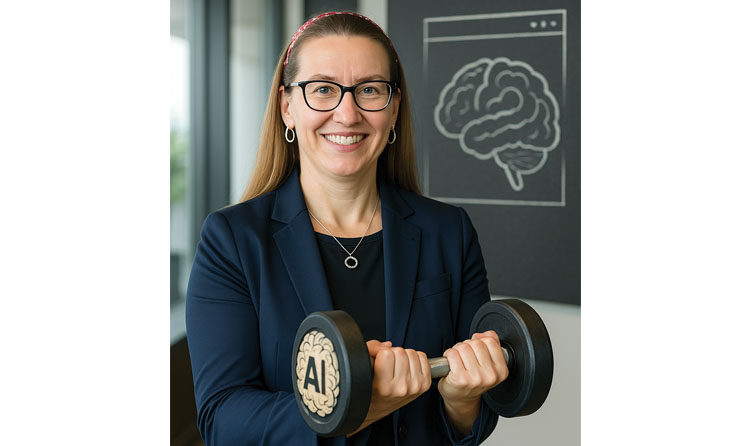
Enter the 28-Day AI Challenge. I treated AI tools like mental resistance bands — not to make my work easier, but to make my brain stronger. What started as a personal challenge quickly turned into one of the most energizing exercises I’ve ever done. Here’s what happened when I trained my brain as seriously as my body.
Week 1: establishing a baseline
Day 1–3: Picking tools and setting goals
For me, “mental fitness” meant sharpening creativity, analysis, and continuous learning. I chose my AI workout gear: Claude for writing, Midjourney for visuals, and ChatGPT with Excel for data drills. These weren’t here to replace me; they were my mental sparring partners.
Day 4–7: Pushing past the easy button
At first, I coasted. “Write a professional email,” I’d say, and AI would deliver. But I wasn’t thinking critically. So, I made a rule: for every AI-generated response, I had to contribute original thought, in both the prompt and the edit. It became a workout, not just a shortcut.
Week 2: finding my routine
Day 8–10: Prompt engineering = mental weight training
Crafting better prompts reminded me of progressive overload at the gym: Start simple, then add complexity. One night, I spent two hours refining a prompt about financial trends. The value wasn’t just in the output; it forced deeper thinking. The gains were real.
Day 11–14: Creative reps
I gave myself 20-minute “creativity sprints” using AI image generators. I’d prompt weird visual mashups, then build stories or business concepts around them. It broke familiar thought patterns and sparked ideas I never would’ve explored otherwise.
Week 3: hitting and breaking the mental plateau
Day 15–18: Fact-checking = core work
Like any workout, I hit a plateau. So, I raised the intensity. Every AI-generated fact had to be independently verified. That sharpened my critical thinking — not just with AI, but in conversations, emails, and daily decisions. My inner skeptic got stronger.
Day 19–21: Teach to learn
I started explaining complex topics to AI using the Feynman Technique (“Big Bang Theory” fans, you know the one). If I couldn’t explain it simply, I didn’t understand it. Suddenly, AI became my accountability partner.
Week 4: synthesis & results
Day 22–25: Creating without a net
I challenged myself to build original content, project plans, essays, and creative ideas, without relying on AI for the core work. The tools became sounding boards, not crutches. The result? Sharper thinking, more structure, and ideas that felt truly mine.
Day 26–28: Rinse & reassess
I revisited early tasks to test my growth. The difference was clear: I asked better questions, explored more angles, and reached deeper insights. Mission accomplished.
The mental fitness routine lives on
This wasn’t a 28-day fad. I’ve kept going. Daily AI sessions have become my cognitive gym time. Why? Because here’s the truth: AI doesn’t make us smarter. But using AI deliberately and critically? That does.
These tools amplify human thinking when we engage with them as partners, not autopilots. Just like strength training, real growth comes from resistance. AI is now my favorite resistance training for the brain.
My gym keeps me physically fit. My AI tools? They keep my thinking sharp. And that might be the most important muscle of all.
My favorite AI tools (A short but mighty list)
People often ask me which tools I actually use. Here are the ones that deliver:
ChatGPT: My everyday sidekick. If I had a nickel for every time I used it…I’d have more time to use ChatGPT.
Claude: My go-to for editing. Like a calm, thoughtful writing partner who doesn’t over-caffeinate.
Jasper: Great for outlines and scripts. Think of it as your brainstorm buddy that never burns out.
Napkin AI: Ideal for slick visuals in presentations when your brain says “nope.”
Midjourney: Stunning, high-concept images. Perfect for storytelling and branding.
Notebook LM: Turns dense training docs into digestible podcast-style summaries. Smarter commuting, unlocked.
Runway: Video content creation made easy. Like having a Hollywood studio in your browser.
Suno: A music generator for custom soundtracks or when you just want to pretend you’re a composer.
Krisp: A lifesaver for remote workers with noisy pets. Silence the Amazon truck freakouts.
Second Nature: An AI sales coach that works. Great for training reps without triggering eye rolls.
KATHERINE BEATY is executive vice president of customer experience for TEZ Technology. She can be reached at [email protected].