

By Chris Phenner
Artificial intelligence (AI) is reshaping how consumers find and buy services, including parking: Clicks to traditional websites are plummeting rapidly as AI now appears within 50% of all Google search result pages, most of which are no longer generating clicks.
The solution lies within “small spaces” — tiny digital placements within AI search results, voice assistants, and autonomous purchasing agents where parking can be booked easily. For the $100-billion parking industry, success depends on embedding booking capabilities directly in emerging, AI-powered touchpoints. Parking needs to be where drivers are searching.
Small spaces, more bookings
Parking technology provider Flash has built more than 35 “Integrations” with various digital channels. These include dozens of sports arenas like SoFi Stadium, websites like Groupon, ticketing sites like SeatGeek and Ticketmaster, and navigation platforms like Google Maps and Waze. These integrations drive hundreds of millions of dollars in annual bookings.
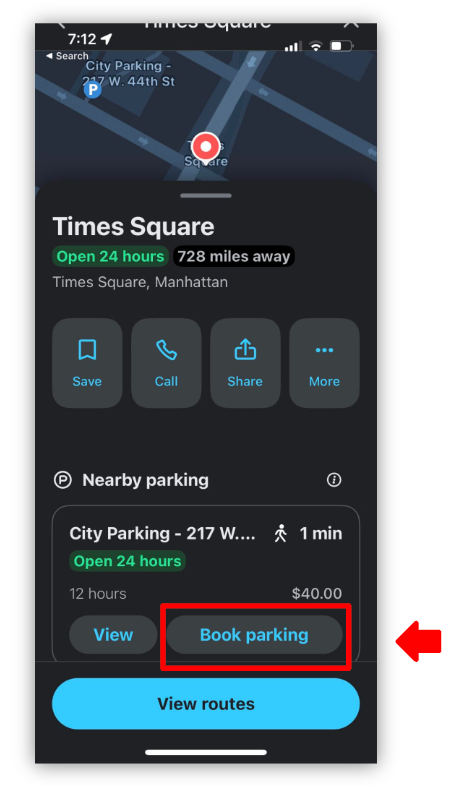
When building its partner integrations, Flash looks for small spaces within which to show nearby parking. Small spaces are digital placements within apps and websites that show the availability, location, and price of parking. Purchases happen with only two taps. Below is our partner integration with Waze, where “Book parking” is shown within a small space:
Showing nearby parking in small spaces becomes more important as AI becomes more prevalent. Forbes reports that 60% of searches now drive no clicks. Google launched AI Mode in March 2025, and it provides zero blue links and, therefore, no clicks. Websites are seeing approximately 35% fewer clicks than a year ago. Google shows what it calls “AI Assistant blurbs” for some 50% of keywords.
In a world of rapidly diminishing search results that drive no clicks, parking information needs to be delivered in small spaces, whether that is within the copy of AI search results or in agentic apps. An agentic app is one in which AI services make purchases for users by automating several steps.
This past January, OpenAI — the creator of the large language model ChatGPT — launched the AI agent known as Operator, which automates tasks on websites. In April 2025, Amazon announced its Buy for Me service, which automatically buys products that are not available on Amazon’s sites. The AI-powered answer engine Perplexity has integrations with payments providers PayPal and Venmo, and the company recently announced an integration with OpenTable, the website and app used to book restaurant reservations. If restaurant tables are booked with AI, parking will follow.
This is not the first time small spaces have presented an opportunity. In the 1990s, websites integrated using iFrames — in other words, a page within a page. That evolved with the XML feed, which evolved into the application programming interface (API). Small spaces have driven clever partnership integrations for decades.
AI brings new methods and systems that “feed” parking information into AI models. APIs still matter, but they are being complemented by a more recent technique known as retrieval-generated augmentation (RAG). RAGs permit AI model to access what they consider to be authoritative databases — for example, Flash’s more than 10,000 digital parking locations. RAGs reduce so-called hallucinations and enable AI search results to contain citation links, which could also serve as links that enable agentic commerce experiences.
Specialized servers known as model context protocol (MCP) servers play a role in providing computation that can enable tasks such as image recognition, natural language processing, and predictive analytics. MCP servers are a bridge to real-world information, enabling AI models to access up-to-date, specialized, or business-specific data, and interact with external applications through an open, secure protocol.
The best nearby parking place
Given all these changes, Flash often designs for one search result. This is new. When you think about “search results,” you might envision a wall of blue links from Google. But when Flash started building our integration with Waze, we realized we only had pixel space for what was labeled “The Best Nearby Place.” AI’s ability to take into account so many more variables plays into this well.
The term conversational user experience refers to the design of a user experience that welcomes natural language as its primary input. In some ways, it blows up the conventional search process. It blows up conventional app and website design. In fact, some say all software will have a conversational interface and work with agents. In a key example of this line of thinking, Satya Nadella, Microsoft’s CEO, asked, “‘Why do I need Excel?” on a podcast in December 2024.
AI in cars makes sense
Automakers and navigation system providers see the value of in-vehicle parking, because it may unlock in-vehicle transactions. For those integrations, Flash Data is finding its way into the smallest of spaces yet — the dashboard. We are being challenged to build user experiences across both companion apps and dashboards. This calls for three modes of input:
- App (typing)
- Dash (tapping)
- Voice (speaking)
Last month, auto navigation map providers Mapbox and TomTom released MCP servers, enabling third parties to access their geospatial, mapping, and traffic data. Both companies are working on voice-enabled interfaces that act as agents to find helpful services for drivers along their routes. AI-enabled integrations like these will inevitably enable parking transactions.
If the parking industry wants to continue to bring digital parking transactions closer to drivers across digital surfaces, we must welcome the growing number of small spaces, as well as any new acronyms that come along with them.
Chris Phenner is the vice president of business development for Flash, Inc. He can be reached at [email protected].